
It does not depend on the time machine at all. It depends on the nature of time itself.
It may also depend on both the nature of time and the time machine.
This would for game purposes be time travel; it would involve isolating the traveler from the causal stream, which constitutes isolating him from time, and then adjusting the flow of the causal stream as desired, which constitutes temporal mechanics.
Would this form of time travel be different from any of your theories?
I've got an entire web site addressing issues like this, and I feel foolish using my time to address them again here when I could just tell you to go read the hundred or so pages of time travel work I've already done.
I think I probably have read the answers before in the replacement theory section but I still do not quite understand why the time traveler could exist in the past in the first place if their action is to prevent the time travel itself after going back to the past. Would it be correct to imagine the causality of time traveler as some thread that loops back to the current time traveler which probably look like a chain? I would be grateful if you can point me to the right direction or website that addresses that issue.
without changing anything.
You are right about the phrase "changing anything". It should be changing anything that "matters". I could be wrong though because if the time traveler arrive at the past, the time traveler would emit some wave or material. What would happen if the emitted wave or material gets into the time machine in the future?
Would this cause an infinity loop to the particular wave or material?
If the location of time travel arrival is not changed for example, would the AB traveler collide with CD traveler or something?
That is, if the AB time traveler went from 2010 to 2000 and then died, then the CD traveler must also go from 2010 to 2000 and die, because if he doesn't then we have two different histories, one in which the time traveler arrived and died, and the other in which he never arrived, and even if that is the only difference between the two histories, as long as each supports the other we cannot have a single stable version of history and thus we cannot have a future built on a single stable version of history. Time ceases.
That is what confuses me about it. Why can there be only a single stable version of history?
The time travel itself destabilizes history which would make it have at least two states. So, is there any reason why only a single stable version of history could make time continue onwards?
If an opposite party knew about the time travel and succeeds in stopping it, would this cause an infinity loop?
I hope this helps.
Yes, thank you very much.
*****
Is that a decent summary of what your character is trying to do in your game thread? I've been trying to wrap my head around it, and this sounds kind of like my working theory of what you may have been trying to say.
Yes.
It does not depend on the time machine at all. It depends on the nature of time itself.It may also depend on both the nature of time and the time machine.
Well, yes, in the sense that it might be possible to build a machine which you thought was taking you to the past but was actually taking you somewhere else. The reason that is unlikely is given in The Two Brothers: Why Multiple Dimension Theory Is Not Time Travel, but the short version is that if your first time travel experiment resulted in the time traveling object vanishing never to appear again, you would assume that your time theories were all wrong and never send another object by that means.
It could be different in a number of ways.This would for game purposes be time travel; it would involve isolating the traveler from the causal stream, which constitutes isolating him from time, and then adjusting the flow of the causal stream as desired, which constitutes temporal mechanics.Would this form of time travel be different from any of your theories?
For one thing, it might be plausible to reverse causality in a limited area--the people and events here on the ground ran backwards, but the stars continue forward, which results in confusion for those who are aware of the stars.
It would also meant that entropy in the universe would continue to increase even though locally it would be reversed.
In short, in this case you are not actually or really traveling in time, but causing the world around you to move backwards instead of forwards, from effect to cause instead of from cause to effect. Time is still moving forward in that part of the universe, but every means of measuring time is moving backwards. (This might depend on the scope you're covering. If you're causing the planet itself to spin backwards and move backwards in its orbit, the shift in the stars might be imperceptible; but the shift in the planets might be noticeable if they were continuing in their orbits. I should also mention that to the best of my knowledge no one has established whether the stars in your present universe are other than fireflies stuck on that big black thing that covers the sky, or that they're not angels dancing in the dark, nor whether there are other planets. The world might be flat, for all you know.)
...I still do not quite understand why the time traveler could exist in the past in the first place if their action is to prevent the time travel itself after going back to the past. Would it be correct to imagine the causality of time traveler as some thread that loops back to the current time traveler which probably look like a chain?
You've probably seen this image (I don't think I can post an image, but if I can it should appear <img src='http://www.mjyoung.net/imgsrc/anom.jpg'>here</img>. The second image from the left, marked "infinity loop", displays time (the past at the bottom) in that situation. At point A the time traveler has not yet traveled in time, but at point B he leaves trying to reach point A; his arrival in the past makes that point C, where he duplicates himself (an older self who traveled from the future and a younger self who has not traveled through time). If somehow the older traveler prevents the younger traveler from leaving from point D, then no one arrives at point C--the older traveler has now ceased ever to have existed, and the younger traveler who is now the age at which the other made his trip does not do so. Thus no traveler arrives in the past, and point C reverts to become indistinguishable from point A, the history in which no time traveler arrived. But we know that the events flowing from point A lead to point B, where the time traveler will travel to C and prevent his doppelganger from leaving from D resetting history to point A, and that's why it's an infinity loop. (That's what John fears; there is no known way to escape one, nor even to realize that it is happening.)
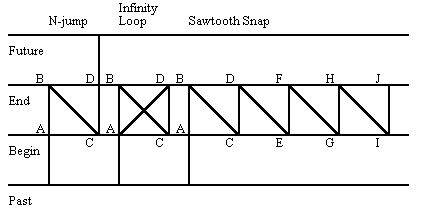
I'm not sure what you mean by "look like a chain", so I can't answer that part.
You are right about the phrase "changing anything". It should be changing anything that "matters". I could be wrong though because if the time traveler arrive at the past, the time traveler would emit some wave or material. What would happen if the emitted wave or material gets into the time machine in the future?
Would this cause an infinity loop to the particular wave or material?
If the location of time travel arrival is not changed for example, would the AB traveler collide with CD traveler or something?
There are three general possibilities here, as illustrated in that diagram.
- I've had to make the assumption that individual molecules are interchangeable. I don't know how credible that is, but in essence it matters that there are thirty seven billion molecules of oxygen in the tank, and not which thirty seven billion molecules they happen to be. Thus if the change becomes "insignificant" in the sense that everything is the same except for the individual identifies of subatomic particles, we have an N-jump, because nothing changed that will not result in exactly the same changes.
- If whatever impacts the time machine prevents the time travel event from occurring, then we revert to point A, the non-arrival of a time traveler, and so wind up in an infinity loop.
- If the impact is slight such that the time trip still occurs on schedule but something is different, we move to a sawtooth snap. That means that each history is a little different from the previous one, but each of them leads to a very similar trip through time. Typical examples of this are when the time traveler contacts himself. Having done so, he changes himself, and so he changes the version of himself who travels back to contact himself, making the changes slightly differently, and so changing himself yet again. It is theoretically possible for this to happen perpetually (like an irrational number), or to replay itself in a loop (like a repeating decimal), or come to an N-jump ending and continue based on the last history.
That is what confuses me about it. Why can there be only a single stable version of history?
The simple answer is that on the day after the time traveler leaves for the past, everyone is going to have to have a coherent unified memory of what happened the day before yesterday, and everything that exists today has to be linked causally from that.
In Bender's Big Score there is a throwaway scene in which Bender, trying to track down and kill all the Frys in the world, rushes into a polling place in Florida where someone named Fry is chatting with Al Gore about how good things are going to be once Gore is elected, and there is a huge stack of Gore ballots being counted. Bender's stray shot destroys them, costing Al Gore the election. As I argue in Bender's Big Score part 9: The Gorey Details, if Gore had won the election in 2000, there is almost no chance at all that Obama would have been a candidate in 2008. But if it's perfectly all right for both histories to remain, then either Obama both is and is not the President of the United States now, or there are two separate universes. Since I argue that multiple dimension theory only mimics time travel, there can't be two universes involved in genuine time travel. Thus there can only be one universe, and for that universe to have one current reality it must have exactly one actual history leading to that reality. Anything that is not part of the history that leads to that reality never happened; if it happened in a necessary alternate timeline, that timeline has been erased, has "unhappened", and now never happened.
You can't have two histories of the present world, because if you do you have two conflicting realities in the present world, and there is only one reality in any given universe.
If an opposite party knew about the time travel and succeeds in stopping it, would this cause an infinity loop?
Almost certainly so, unless it took very specific precautions.
Let's suppose that in 1980 Marty McFly decides to travel to 1920 and kill Adolph Hitler. Let's further suppose that he succeeds in doing so. Some researcher named Doc Brown in 1970 realizes that there was a crime in 1920 perpetrated by a time traveler from the future. He cannot identify the time traveler, but he determines to stop him.
If Doc Brown manages to prevent Marty McFly from making the trip from 1980 to 1920, that action will mean that Hitler was not killed; it will also mean that Doc Brown never discovered that the killer came from the future, and so never prevented McFly from making the trip, and so McFly will make the trip.
Brown has an alternative: he can hop in his time machine in 1975 and travel to 1920 and take action in 1920 to stop McFly from killing Hitler. That will have exactly the same effect, though, because now Brown can't make that discovery--unless somehow Brown in 1920 manages to leave information which his doppelganger in 1970 will recognize, and so communicate to himself that he must make the trip in 1975 to stop McFly in 1920. The information would have to be quite exact: his alternate self will have to travel from the same point to the same point for the same reason. There may be a sawtooth snap as the ripples of change stabilize. It might be more serious--Brown might have caused himself never to have existed (Brown is alive in the altered history created by McFly; he might not have been part of the original history). But there is at least a chance that an infinity loop can be avoided this way.
I use something like this, only considerably more elaborate, for my solution to make 7 Days possible. It involves passing data through a third party and preventing the time travel team from knowing whether the information they receive is fresh information based on events that happened or data they already delivered to the past for a disaster they have already rectified. Once events have been undone, the only way there can be knowledge of them is if that knowledge is passed from the future to the past and preserved in the next timeline in the same way.
--M. J. Young
You've probably seen this image
Yes I have.
Thus if the change becomes "insignificant" in the sense that everything is the same except for the individual identifies of subatomic particles, we have an N-jump, because nothing changed that will not result in exactly the same changes.
If a being have the ability to observe the changes to subatomic particles, would that being have to stopped from activating their ability so that N-jump can happen?
Anything that is not part of the history that leads to that reality never happened; if it happened in a necessary alternate timeline, that timeline has been erased, has "unhappened", and now never happened.
Is there a reason why the necessary alternate time line does not have a future?
What would happen to the person that sends the time traveler to the past?
Does this person time somehow stops or does this person time continue onwards?
You can't have two histories of the present world, because if you do you have two conflicting realities in the present world, and there is only one reality in any given universe.
The replacement theory that you said actually make the causality travel forward in a state manner.
The diagram below shows what the replacement theory will do if the time traveler attempt to alter his own value. The value after a letter will increase to represent causality.
Here is the initial state of time:
A-0-B-0-C-0-D-0-E-0-F-0
Here times flow normally:
A-1-B-0-C-0-D-0-E-0-F-0
A-1-B-2-C-0-D-0-E-0-F-0
A-1-B-2-C-3-D-0-E-0-F-0
Here time A is rewritten after time traveler travels from D to A to stop self:
(* represents the time that is changed by the time traveler)
A-4*-B-2-C-3-D-4-E-0-F-0
A-4*-B-5*-C-3-D-4-E-5-F-0
A-4*-B-5*-C-6*-D-4-E-5-F-6
Here time A is rewritten after time traveler does not travel from D to A:
A-1-B-5*-C-6*-D-7*-E-5-F-6-G-7
A-1-B-2-C-6*-D-7*-E-8*-F-6-G-7-H-8
A-1-B-2-C-3-D-7*-E-8*-F-9*-G-7-H-8-I-9
Here time A is rewritten again after time traveler travels from D to A to stop self:
A-4*-B-2-C-3-D-4-E-8*-F-9*-G-10*-H-8-I-9-J-10
A-4*-B-5*-C-3-D-4-E-5-F-9*-G-10*-H-11*-I-9-J-10-K-11
A-4*-B-5*-C-6*-D-4-E-5-F-6-G-10*-H-11*-I-12*-J-10-K-11-L-12
As you can see, time still continue onwards if replacement theory is used but there will be some sort of ripple that changes history.
In 'Metaplanetary', a peculiar kind of 'time tower' which is a peculiar kind of LAP (Large Array Person) is Thaddeus Kaye who has been imprinted on the local aka solar system wide causality field so much so that if TK dies he might create a temporal black hole which might give birth to other universes with different basic rules.
LAP are a few human bodies (an original and a few clones) and a number of computer copies of the original spread out in different places throughout the solar system so that a LAP could be talking to his love on Earth, calculating sales for feedstock out on Saturn, doing art in his virtual reality apartment near Mars, and doing an experiment near the Sun all at the same time. Obviously this requires instantaneous FTL comms.
Time towers were LAPs designed to experience a decade as a single moment.
TK even more so became the local time field.
I'm not sure what to make of this, but I thought you might find it interesting.
If a being have the ability to observe the changes to subatomic particles, would that being have to stopped from activating their ability so that N-jump can happen?
The working theory is that subatomic particles are not distinguishable from each other; all that can be observed is their state and relationships, and the causal chains will still work given a different set of subatomic particles in the same states and relationships.
That is, if we have ten molecules of water, each has ten protons, seven neutrons, I believe eight electrons (might be wrong--my molecular chemistry is not that good), plus some number of muons, tachyons, and other subatomic particles. They stand in relationship to each other within the atoms. In sending ten molecules of water to the past, it matters that we have sent those ten molecules which are drawn from a specific set, but it does not matter whether they are the same protons, neutrons, electrons, and other particles, as long as they are the same numbers of such particles in the same relationships.
I think you're asking whether the ability of a creature to observe these subatomic particles would make a difference to the anomaly, but I don't see how it could. How would they be observed?
- They might be observed from any point of time up to the moment of their departure. In this case, their arrival is irrelevant, and if that observation began prior to the moment of arrival we know that none of the particles departing were among those arriving. If it happens to be the stabilized timeline, the observer expects to see those particles vanish, and thus his observation is interrupted by their departure.
- They might be observed from the moment of their arrival forward. In this case, the observer was awaiting their arrival with his attention focused on that point; but he did not observe them prior to their departure, and it is not necessary that these particles depart at the end of the history, so the observation is irrelevant.
- The observer might travel with the particles, in which case he would see the same particles arrive as he saw depart; however, the observer who departs exists sequentially before the one who arrives, and the one who arrives is not going to depart again, so it will in that sense be a "different" observer observing a "different" collection of subatomic particles, in the sense that that observer and those particles have not yet made this trip. That observer will also see the same particles arrive as depart.
- Even if there were a way for the observer to observe particles arriving in the same timeline from which he observes them departing (which I cannot find as I think about it), he could not detect any difference in the arriving particles as compared with the departing particles, because the transition would still be completely smooth: particle one leaves point B and particle 2 arrives at point C, and all the world changes around the particle, but the particles are indistinguishable from each other and there was no instant at which they were observed not changing.
Is there a reason why the necessary alternate time line does not have a future?
What would happen to the person that sends the time traveler to the past?
Does this person time somehow stops or does this person time continue onwards?
Abe and Bob build a time machine. The started building in 2000 and finished in 2020. In 2020, Bob operates the machine and sends Abe to 2010.
Either Abe arrived in 2010 or he didn't.
If he arrived in 2010, it doesn't matter whether Bob knows it or not before 2020; the fact is, Abe exists in the past, at 2010, when before he didn't. Abe will change the universe by his presence, even if Bob and Abe's counterpart, who are now working on that time machine in 2010, don't know this. So the logical solutions are:
- Abe arrived in 2010, but that this did not change anything because you can't change the past, and thus Abe always arrived in 2010. Nothing Abe or Bob can do will prevent them from creating the time machine on schedule in 2020 and sending Abe to 2010, no matter what disaster Abe causes; it won't be a change, but will be what happens in history.
- Abe thinks he has arrived in 2010, but he is actually in another universe. In Bob's universe, Abe vanished never to be seen again, and Bob now knows that their time travel experiments are a failure, that he has killed his friend Abe. In Abe's universe, it does not matter whether Bob and Abe finish the time machine, except that if Abe never leaves for 2010 in that universe there will always be two Abes in that universe, one ten years older than the other, one who came from a future that might never come to be in this universe. This is not time travel; it is dimension travel.
- Abe does arrive in 2010 and so changes history. There "was", in a metaphysical sense, a previous history in which he did not arrive, but that history has "unhappened" and a new history is created which includes Abe's arrival. As to Bob, the 2020 version of him has not yet existed, but his 2010 version is working on the time machine. When 2020 arrives, he will exist in whatever form the altered history gives him, which might be exactly the same and might be entirely different. If he is different enough that Abe's memories of him are different, then the Abe that arrived in 2010 also is replaced by the new Abe that makes the trip from 2020--what we would call the "second" trip, but that the "first" trip has now never happened (whether or not the "second" trip occurs).
Bob doesn't cease to exist, really. He simply reverts to who he was at the time of Abe's arrival and becomes whoever he will be given the changes to history. Bob has a future--the same future everyone has now that Bob and Abe have changed the universe such that there is a different future for everyone.
When you think about it, there wouldn't be much point to changing the past if the past of your own universe isn't going to change; and it wouldn't be time travel if you were changing the past of someone else's universe. Either Bob's universe changes and Bob with it, or Abe is in a different universe and never actually traveled to his own past.
I don't understand your symbols in your efforts to describe timelines--what are the "0"s? What do the numbers represent? But the short answer is, either the time traveler enters the past and changes the universe for everyone everywhere such that the old history never happened for anyone anywhere, or the time traveler enters the past and cannot change anything because he was always part of the past, or the time traveler does not enter the past but travels to a different universe and changes nothing in his own history but events in another as yet unformed timeline.
There is no way that a time traveler can travel to his own past and change it and also not change it at the same time.
--M. J. Young
In sending ten molecules of water to the past, it matters that we have sent those ten molecules which are drawn from a specific set, but it does not matter whether they are the same protons, neutrons, electrons, and other particles, as long as they are the same numbers of such particles in the same relationships.
If that is the case, would copying the state just before the time travel takes place and then making a twin with that same state go through the time machine avoid any temporal anomalies?
Must this twin leave at point D or can this twin leave between point C to D to avoid temporal anomalies?
(If you say that the twin must leave at point D, why this is so and why not from earlier or later point?)
They might be observed from the moment of their arrival forward. In this case, the observer was awaiting their arrival with his attention focused on that point; but he did not observe them prior to their departure
If a person with perceive history skill use it to such particle, would this prevent N-jump?
particle one leaves point B and particle 2 arrives at point C, and all the world changes around the particle, but the particles are indistinguishable from each other and there was no instant at which they were observed not changing.
Even if viewed with a skill such as perceive history or future?
Would such person be able to view the original and altered time line?
There "was", in a metaphysical sense, a previous history in which he did not arrive, but that history has "unhappened" and a new history is created which includes Abe's arrival.
If history has "unhappened", Abe would actually stay in the world where the causality have been reversed. It could be argued that Abe have not travel back to the past but the world is reversed to be like the past with the exception of Abe's "arrival".
That also reminds me of the film "Prince of Persia: The Sands of Time".
there wouldn't be much point to changing the past if the past of your own universe isn't going to change
The past of the universe is changing but if the time ripple rate of change is the same with the rate of change of original universe, then the original universe would not perceive the change. If you accelerate the time ripple into the future then the universe will be changed with it. This would make communicating with the person in the original future possible as long as the time ripple rate of change remains equal to the future. If it is not equal then it could also be done but it will be much harder. This would also meant that a time portal is possible. If for example the time traveler has finished the mission given, the time traveler could speed up the time ripple (accelerate causality) so that it will rewrite the future. This would also meant that the person in the original history would not be rewritten as long as the time ripple does not catch up to them.
I don't understand your symbols in your efforts to describe timelines--what are the "0"s?
0 would mean that nothing is written yet. For example, in the original time line, if someone tries to go the future, that person would come to a barren universe because nothing have happened yet. The existence of non-barren future universe could mean that there have been successful attempt of time travel before that time line. This would also depend on whether there is the element of "fate" or "destiny" present. If there is then the future would not be barren and the past could only be visited if that person is fated to do so. In this type of world, "now" have already happened for the Creator but for the creature, they will pass from point of lower causality to higher causality relative to that creature.
What do the numbers represent?
The numbers represent causality or total entropy. The highest number available would represent "now" or "the present". For the time traveler, it would be the highest number and the symbol (*). For the people who sends the time traveler, this would be the highest number without the symbol (*).
There is no way that a time traveler can travel to his own past and change it and also not change it at the same time.
They can if the ripple of time to the future is equal for the "present state". If the ripple of time for the time traveler is accelerated then the future where the time traveler would come from would be rewritten. If the change affected by the time traveler would travel through the future and back to self instantly then the time traveler could not do things that can affect self in the past. This would cause the time traveler to merge with past self and do the exact same thing as the time traveler would do in the past. If the change affected by the time traveler would travel through the future normally then there is no reason not to believe that the change affected by the person (who sends the time traveler back to the past) to travel through the future normally too unless the time machine stops the causality of this future and uses this energy generate the travel of time traveler back to the same point. If this is the case, when the time traveler comes to point D, the time traveler would have to reverse this process (by setting the time machine before point D happens) so that infinity loop can be avoided by stopping the causality that would happen to past to generate energy so that the time traveler could continue onwards to the future.
If that is the case, would copying the state just before the time travel takes place and then making a twin with that same state go through the time machine avoid any temporal anomalies?
I have no idea what this means.
Must this twin leave at point D or can this twin leave between point C to D to avoid temporal anomalies?
(If you say that the twin must leave at point D, why this is so and why not from earlier or later point?)
Any object or person (but not necessarily information) traveling to the past creates a temporal duplicate of itself. That is, if I travel to yesterday, there are two of me yesterday, the one for whom the previous day sequentially was the day before, and the one for whom the sequentially previous day was today. The one for whom yesterday followed from the day before must today travel to yesterday, in essence "becoming" the the other. The universe needs him to be identical at the moment of his arrival to the one who arrived previously.
If you copied me just before I left, that would advantage you nothing. The copy of that version of me would cease ever to have existed at the moment that history is erased. If there were no significant changes to history from my trip, you would in the revised history copy the other version of me (the one who has not made the trip) and sent that original back, giving you another copy of him; if history stabilizes, that copy would continue to exist after point D, along with its original which traveled to the past (and may or may not have returned), but that has nothing to do with the time travel. If you did not copy the other version of me, that would be a significant change in history, and you would have to repeat history again to get a stable version. If you copied the version of me who already made the trip to the past and sent him to the past instead of my non-time-traveling doppelganger, you would probably create a very complex anomaly. The "stable" version would have you copying the copy and sending the copy of the copy back, and doing so with every timeline, and I'm not certain whether this would ever stabilize. It might depend on the method of copying.
It seems to me that having a time traveler leave before point D can result in a stable history, although it would be rather complex and it would also be necessary for that traveler to leave at that exact time in the next history to do so. There is also significant uncertainty as to whether the other traveler would be in the past or not, and that adds to the complexity of the scenario. My thinking is something like this:
- At the end of the original history in which no time traveler arrives, Abe leaves for the past, from B1 (that is, point B of the first anomaly) to C1.
- The arrival of Abe at C1 initiates a new timeline, in which at some point before D1 Bob leaves, creating point B2, the departure point of the second anomaly, and point C2, the arrival point of the second anomaly. It is clear that if C2 is later than C1, Abe is already there; it thus follows that if C2 is earlier than C1, Abe will arrive at C1.
- If at D2 the other Bob makes the same trip to C2, that history is confirmed and we have an N-jump termination. However, if Bob's trip has prevented Abe's trip, Abe does not arrive at C1, and Abe's history reverts to the AB history; however, Bob is already present from B2, and thus we now have a history in which Bob appears but Abe does not. If Bob again prevents Abe from departing from B1, then Abe's anomaly is erased, Abe never made the trip and his history isn't even history. However, if Bob prevents Bob from leaving from D2, Bob's history reverts to Abe's AB timeline in which no one arrives in the past, and we have interlocking infinity loops. If on the other hand Bob does not prevent Abe from leaving from B1, then Abe creates an infinity loop in which Bob's stable anomaly exists on both sides.
It is much more difficult to determine what would happen if Abe (the second Abe who did not come from B1 but was in this universe at C1 when his counterpart arrived) replaces Bob in the second anomaly and targets C1. Depending on some pretty complicated questions, you would either have two Abes both of whom must confirm their own trips to get overlapping N-jumps, or you would have one Abe who has to confirm the second anomaly in a way that undoes the first on both sides (doing what Bob would have done but in the absence of the duplicate Abe). In the first case, the Abe that came from B2 must do what he is doing and then become the Abe from D1, which will create a sawtooth snap in the first anomaly (because the original Abe from AB1 did not make the second time trip) until both anomalies stabilize into one history.
I write letters to people about these things all the time, but it's not easy to explain or to understand, so don't be too upset if you're not getting it.
If a person with perceive history skill use it to such particle, would this prevent N-jump?
Ah, I see what you mean. If a particle has a perceivable history, that makes it a unique particle. I'm afraid I'm going to have to argue that particles do not have histories individually, or if they do then providence assures that the same particles are in the same place at the right time to avoid anomalies. In a purely technological world it's simple enough to say that a particle has no discoverable history but is interchangeable with every other particle. In a magical world it is simple enough to argue for a providential intervention in this regard. The problem arises only in a high psionics world. The answers psionics does not treat chemistry and physics by technological rules, and thus from a psionic perspective matter is not really made of atoms of subatomic particles, but of substance that is material and takes certain forms under scrutiny. That is, you can in theory observe the structure of an atom psionically, but you observe and manipulate it under rules of psionics, not of technology, and thus the structure is essentially an observed, not an actual, reality. The parts are not distinguishable from the whole in that sense. Particles are thus interchangeable within objects, and the molecules themselves do not have discoverable history apart from the object itself. You could discover that this piece of ice came from that lake, but you could not trace the origins of individual molecules of water beyond that.
Even if viewed with a skill such as perceive history or future?
Would such person be able to view the original and altered time line?
Thinking about it more, I see what you're saying, and I see what I think is a solution, given what was already said. Forget for a moment that we are talking about particles, and let's talk about objects.
In the AB timeline you are looking at an object and perceiving its history. You discover that its history traces back before point A.
In the CD timeline the object you are examining comes from point B. That's already a change in history--in the AB timeline you were not examining an object that came from the future, because no such object existed. Somehow the arrival of the object from the future has prevented you from examining the original object and called your attention to the new one (or perhaps it has caused you to examine an object when you had not done so in the original history--either way, this is a change). You observe that this object came from the future, and you learn facts about it that were true in the AB history.
The object's temporal duplicate--it, the version of it that did not exist in the AB history--makes the same trip from point D. It arrives at the same moment that is point A and C, and you observe it. If everything (discoverable) that ever happened to it is identical to what happened to the same object from the AB timeline, then everything you discover is the same: it came from the future, and the facts that were true about it in the AB history were true about it also in the CD history. Note that this can be true even if there are different molecules comprising the substance, as long as those molecules have the same history as far as is discoverable. If instead there is something discoverably different because of the changes made by the arrival of the object at point C, we are at point E, and you are examining the object that came from point D. One of two things now happens: either the object that leaves from point F is indistinguishable from that which left from point D, and the EF timeline stabilizes as the final history of the N-jump termination, or the arrival of the object in the past will always change the object that departs from the future, and we have a sawtooth snap.
Since the specific atoms and particles comprising an object are more likely to be changed than not, I conclude that either such particles do not have history individually or time travel is impossible or any time travel event will destroy time. Since within the game I know that time travel is possible and does not always destroy time, I conclude that particles do not have individual histories.
If history has "unhappened", Abe would actually stay in the world where the causality have been reversed. It could be argued that Abe have not travel back to the past but the world is reversed to be like the past with the exception of Abe's "arrival".
I disagree. If you have reversed causality, the cause of Abe's arrival at point C lies in the future, and thus you would undo his presence in the past and bounce to the moment of his departure in the future, presumably at point B. You have to undo causality all the way to point A to get to the moment before point C by that method. Real time travel could skip that, though, going directly to the past.
Haven't seen it; hadn't heard that it had time travel elements. Should I be planning to get a copy of this for my temporal anomalies series?That also reminds me of the film "Prince of Persia: The Sands of Time".
Sounds like Sergiy Koskin's theory, which I reject. It also sounds to me like multiple dimension theory of some form. The notion of a ripple requires a second dimension in time, that time could change against a medium of time, but despite my considerations of that possibility I don't find it credible.The past of the universe is changing but if the time ripple rate of change is the same with the rate of change of original universe, then the original universe would not perceive the change. If you accelerate the time ripple into the future then the universe will be changed with it. This would make communicating with the person in the original future possible as long as the time ripple rate of change remains equal to the future. If it is not equal then it could also be done but it will be much harder. This would also meant that a time portal is possible. If for example the time traveler has finished the mission given, the time traveler could speed up the time ripple (accelerate causality) so that it will rewrite the future. This would also meant that the person in the original history would not be rewritten as long as the time ripple does not catch up to them.
Oh, I get it. I disagree. There is a sense in which the future has not been written yet, but also a sense in which it already exists in a form unknown to us. More substantially, if you were to leave the present and travel to the future, you would arrive in a future in which you left from the past and did not exist during the intervening time. Of course, if you returned to the past, you would then alter the history between your arrival in the past and your departure from the future, and that would alter your experience upon arriving in the future, as now you would know a history in which you did return from the future to the past, and you would not know the history in which you never returned.0 would mean that nothing is written yet. For example, in the original time line, if someone tries to go the future, that person would come to a barren universe because nothing have happened yet.
Nope, a ripple change is not plausible. I suppose that a universe could exist in which such things happened, but when I see that in films it sets off my %*!!$#!+ alert, and it won't happen in my games unless there's really good reason to think that time makes no sense at all in this universe.They can [change and not change the future] if the ripple of time to the future is equal for the "present state".
--M. J. Young
If you copied the version of me who already made the trip to the past and sent him to the past instead of my non-time-traveling doppelganger, you would probably create a very complex anomaly. The "stable" version would have you copying the copy and sending the copy of the copy back, and doing so with every timeline, and I'm not certain whether this would ever stabilize. It might depend on the method of copying.
The copy would probably have to know that it is a copy but not how many times it have been copied to stabilize the time. This would work if the copy is indistinguishable from the previous copy by making the copy save the state of arrival to before departure so the data can be copied with high precision.
If there exist two time traveler Abe and Bob,
++++A+++++++B1 (Time from A to B1 to C1 which is previously A)
+C2++C1+++++B2+D1 (Time from C1 to B2 to C2 to C1 where time traveler meet)
+C2++C1+++++D2+D1 (Time from C1 to D2 confirming travel)
If B1 is prevented, then
+C2++++++++B2++ (C1 is prevented)
+C2++++++++D2++ (This confirms it)
If C2 prevents B2, then
++++A+++++++B1 (It loops back to this time line)
+C2++C1+++++D2+D1 (If Abe does not plan to prevent travel)
If Abe prevents D1, then
+C2++A+++++D2+B1 (Time loops from D1 to A to D2 to B1)
+C2++C1+++++D2+D1 (Then to C1 to D2 to D1 then back)
If Abe decides to time travel solo,
++++A+++++++B1 (Time from A to B1 to C1 which is previously A)
++++C1+++++B2+D1 (Time from C1 to B2 to C1 where time traveler meet or be himself who travels through time but I wonder if they would collide or something.)
++++C1+++++D2+D1 (If there is one one time traveler then must make sure self in this time line go through D1 first then to C1 then to B2 then to C1 but because no one can go to time after D2, time will probably loops which makes the time traveler unable to continue forward unless he splits in two. This is because if he goes to D2, he cannot also go to D1 unless he can split himself into two so that one can go to D2 and also D1.)
If become two then the solution the same as Bob would probably work (as long as Abe does not meet self) but I wonder if the solution is the same if Abe tries to go to C2 from B2. If Abe have memories of meeting himself, would this go to sawtooth snap or something?
Since within the game I know that time travel is possible and does not always destroy time, I conclude that particles do not have individual histories.
Or psionicist with view history would know that time have loop a couple of times before thus implanting a message to the particles to warn self (or any other psionicist) and self to put similar warning on similar particles when self tries to view the history of particle.
Real time travel could skip that, though, going directly to the past.
"Real time travel" also have the disadvantage of looping in high psionic world.
Haven't seen it; hadn't heard that it had time travel elements.
I think it uses the reverse causality technique but I could be wrong.
Sounds like Sergiy Koskin's theory
Yes, it does sounds like it because I just interpret replacement theory using the spreadsheet illustration. That is why the theory is similar. I also think I have read the critique and response before but after re-reading it, the "screen wrap" illustration would be more correct to define what your replacement theory really is. That however still makes me confuse about the nature of time. If it is wrapped when time travel happen, would this wrap suddenly vanish after time continue onwards?
Does the time machine create such wrap that filters stable time or something before making the wrap vanish?
What would happen if the time traveler skips point D to the future by making a wrap to the future after knowing that point D is an infinity loop?
Would the time traveler be send back to the past but remembers that this is an infinity loop?
The notion of a ripple requires a second dimension in time, that time could change against a medium of time, but despite my considerations of that possibility I don't find it credible.
The ripple that I mention actually does not imply a second dimension in time but only how the time looks like when it travels to the future. In my mind, it only have one dimension in which the ripple goes forward to the future. The diagram below would probably help.
+++++++++ (Initial state)
A++++++++ (First state as the present viewed by all creature is written)
PA+++++++ (Second state as the present is shifted to the right or the future)
TPA++++++ (Third state as a time traveler is send back to past)
NTPA+++++ (Fourth state as both of them is shifted to the right or the future)
A: The present viewed from creature other than time traveler
P: The past written by the present of other than time traveler
T: The present viewed from the time traveler and the creature of that time
N: New history that is rewritten by the time traveler
There is a sense in which the future has not been written yet, but also a sense in which it already exists in a form unknown to us. More substantially, if you were to leave the present and travel to the future, you would arrive in a future in which you left from the past and did not exist during the intervening time.
If this is a screen wrap, there would be no past between the point of departure to the point of arrival. This is because when the screen wrap happens it freezes the point of departure or does it only freezes the point of departure if the time traveler goes to the past?
If it freezes the point of departure when the time traveler goes to the future, how does the future still exist then?
D=A====B=E=C=F
If I travel from A to B in the future then at point C go back to point D which is earlier than point A to stop myself from going to the future in point A then what would happen?
Would I pass through point B without going through a loop?
If I pass through point B, could I go from point E to point F?
Maxx, I'm having a hard time following a lot of this. I'm thinking that your native language is in the Asian family, and although your command of English is excellent at times the structure is obfuscating. I'm going to do my best to answer, though, if the computer doesn't freeze for the I've-lost-count-how-many-times-today time.
I'm not following what benefit you hope to gain from the copy, nor when you intend to make it. The best guess I can find is that shortly before point B you want to make a perfect copy of the time traveler so you can't tell which is the original and which the copy, and have one of them travel to the past so that if something happens in the CD history that prevents his counterpart from making the same trip you've got the copy. The problem is, the copy ceases to exist at point B unless it is created also at the same moment shortly before point D, and in that case you still have the original from that history from which you made the copy.
Now, maybe you're wondering whether it would be possible, in the event that the AB traveler in the CD timeline does something that prevents the CD version of traveler from being able to make the trip, we could somehow clone a version of the AB traveler such that he has all the memories the AB traveler had up to this moment in the AB timeline, and is exactly that age and that condition, and so is completely indistinguishable from who the original was before he made the first trip, and let this younger copy make the same trip. If the copy does not know that he is a copy, but believes himself to be the AB original, he should do the same thing as the AB original and reach the point at which he concludes that to save time he must make a copy of himself. If the copies truly are indistinguishable from the original (no copy deterioration) then you've got an N-jump based on the CD history as the stable form. It's a rather extreme and improbable way to do it, but it could be done. If the copy knows itself to be a copy, however, it will probably act differently on that basis, and you'll have an EF timeline; this still might stabilize if the copy of the copy is identical to the copy and does not know that the copy was not the original.
If C2 prevents B2,
Every C automatically prevents its preceding B; the question is whether D is sufficiently like B that C will follow from D exactly as it followed from B.
If Abe have memories of meeting himself, would this go to sawtooth snap or something?
That is probably the case. The trick to it is that when the younger Abe who met the older Abe in turn becomes the older Abe meeting the younger Abe, the older Abe will remember the meeting, and is likely to change it even unintentionally based on those memories. Until the time has settled into a sequence in which the younger Abe always does when he is older exactly what the older Abe did when he was younger, time cannot stabilize. (And if that didn't confuse you...I suddenly recall a line from the Red Queen Through the Looking Glass, "That's nothing compared to what I could have said had I tried.")
Bzzzt. Wrong answer, Hans. Would you like to try for Double Jeopardy...?Or psionicist with view history would know that time have loop a couple of times before thus implanting a message to the particles to warn self (or any other psionicist) and self to put similar warning on similar particles when self tries to view the history of particle.
- If it is an infinity loop, the psionicist can't do anything he didn't do in the previous play of this version of history--there is no new cause to get him to do so.
- If it's a sawtooth snap, implanting a message that wasn't there guarantees that history won't stabilize in this timeline, because you have intentionally made the next one different.
- To send a message by implanting it in specific particles, you would have to know that these particles were going to travel to the past, not that they had done so. That is, let's suppose that a certain rock travels to the past, and you find it and discover that it came from the future. You want to send a message by impressing it into the rock--but this is the rock that came from the future, not the one that is going to travel to the past. There is somewhere another identical but slightly younger rock which is going to travel to the past, but at the moment there is nothing at all to identify it but that it is just like this one was before the trip to the past.
- If you swap this rock for the other, you create a sawtooth snap into an infinity loop termination, because this rock will get older and older with each trip to the past until it crumbles to dust, at which time we start over with no rock arriving from the future and the original rock heading for the past.
In any case, I've already ruled that subatomic particles can't carry that kind of information, so the point is moot.
...the "screen wrap" illustration would be more correct to define what your replacement theory really is. That however still makes me confuse about the nature of time. If it is wrapped when time travel happen, would this wrap suddenly vanish after time continue onwards?
If I understand the question, yes, once there is a single history it no longer repeats in an effort to stabilize.
Does the time machine create such wrap that filters stable time or something before making the wrap vanish?
It has nothing to do with the time machine; it has to do with the nature of time itself.
Your question is a bit like asking whether the dynamite that destroys the dam then pushes the water into the valley below. The water flows into the valley because that's it's natural action; the dam constrains it. Time acts in certain ways connected to causality as its natural action; time machines disrupt it momentarily, but it seeks its own stability.
What would happen if the time traveler skips point D to the future by making a wrap to the future after knowing that point D is an infinity loop?
I do not see how it is possible for the time traveler to know he is in an infinity loop. That part is completely immaterial.
If the time traveler leaves from a point between C and D attempting to arrive at a point beyond D and there is no history beyond D, the same thing happens to him as happens to everyone else who reach point D: at the moment we reach point D we revert to point A, ceasing ever to have known any of the events that ever occurred in either the AB or CD histories, and being who we were at that moment.
Would the time traveler be send back to the past but remembers that this is an infinity loop?
Time travelers never know they are in an infinity loop.
The ripple that I mention actually does not imply a second dimension in time but only how the time looks like when it travels to the future. In my mind, it only have one dimension in which the ripple goes forward to the future.
You're failing to understand the notion of the ripple. You have three options, really.
- All of history changes instantly upon the arrival of the time traveler to the past; although we discover the changed history at the speed of time, were we to leap ahead those changes would already be in place.
- The future from which you came does not change, and thus does not exist in this world, and you're creating a new history; but you can't travel to the future except if it is there to meet you.
- It takes time for the changes to propagate into the future--your ripple effect. That means the changes to time are measured against time. You could leap ahead and find yourself in the as yet unchanged future, but whether that means the changes will never catch up with you or that at some moment the world (and all your memories of it) will be altered to match the new version, there is a second concept of time that is measuring the rate at which the changes move through history. It does not make sense to say that 2020 will be unchanged until time moves from 2000 to 2020, because if 2020 exists, time has already moved from 2000 to 2020 and the changes are already there--unless there is a second clock measuring "how long" it takes for the changes to move through time, quite apart from how long it takes for time to move that far.
If this is a screen wrap, there would be no past between the point of departure to the point of arrival. This is because when the screen wrap happens it freezes the point of departure or does it only freezes the point of departure if the time traveler goes to the past?
If it freezes the point of departure when the time traveler goes to the future, how does the future still exist then?
I'm not understanding the concept of freezing the point of departure, but I can confirm that travel to the future is significantly different from travel to the past. However, in both cases all of time alters based on a combination of those events that have led to this moment temporally and those that have done so sequentially. Someone who travels to the future arrives in a way not different from Buck Rogers: he ceased to be part of the history of the world for some period of time, and then re-entered it in the future, and the intervening period has no record of him.
If I travel from A to B in the future then at point C go back to point D which is earlier than point A to stop myself from going to the future in point A then what would happen?
Would I pass through point B without going through a loop?
Let's straighten this out a bit. If you travel to the future, you leave from point A and arrive in point B, and that's the whole anomaly--every trip through time creates its own, but forward trips are extremely simple anomalies as the only odd part is where the time traveler was during that time. We'll call those A1 and B1.
If you then leave from a moment after B1, that's a new anomaly, point B of the second anomaly, and thus we'll call it B2. You're targeting a point A2 but on arrival it becomes C2. (There is no C1 in this event, because the first anomaly did not change the past.)
If C2 is before A1, and you successfully prevent yourself from leaving from A1 for B1, that's not a problem in itself; however, you then will have prevented yourself from leaving from B2, thus preventing your arrival at C2, and making it impossible for you to prevent yourself from leaving from A1, making the second anomaly an infinity loop.
I'm not sure what those letters identify in this example, but those points in time probably do not exist, so you can neither depart from one nor arrive at the other; but you might be using them to designate points for which I have used different designations; I'm just not sure what they are.If I pass through point B, could I go from point E to point F?
I'm hoping that you can ask fewer questions per post. I have spent most of an hour on this, and with the computer problems I'm having from the heat I don't have the time to spend; it may have prevented me from being able to get to the other posts tonight, which would be unfair to everyone else on the board (particularly those who are not interested in the time travel elements). In any case, I do hope this has helped resolve the remaining issues in your mind.
--M. J. Young
Moments after point D of the CD(1) timeline Kyle Reese is sent to the past to protect Sarah; this, too, has already happened. However, Kyle is not sent from point D(1); he is sent from point B(2), the end of the AB(2) timeline; point A(2) is that moment sometime after the arrival of the T-800 at which Kyle does not arrive, and point C(2) is that same moment in the newly created timeline in which Kyle does arrive. That history plays out, and at point D(2) John Conner sends Kyle Reese back to protect Sarah, confirming that history.
OK, this is an aspect of the theory that I never wrapped my head around. What's the difference between the AB1 timeline and the CD timeline? Once the person leaves from point B, he creates point C, time progresses to point D, where the time trip is either confirmed or not. How does he leave at point B and end up in point A1 instead of C? What's the difference between point A1 and C? If it's more just a question of semantics, and there really isn't a difference, why can't you just say "point C" and make it easy to understand? That's an aspect of the theory that I never wrapped my head around.
I was talking about calling a future soldier, you said something about "What happens in the AB history if you call them here?" The answer is that I don't find out about them until the CD history. However, I'm not in the AB history. The AB history is the original history. Since Reese and the Terminator have already come back, I'm obviously not in the original history, no matter how many numbers you put after it. I'm in the EF history. You're saying I'm in the AB2 history. But there is no AB2 history. I'm in the EF history. The AB timeline is gone. What's the difference between AB2 and EF?
I hope that's clear. All of these letters get confusing after a minute.
Two
Let me see if I can do this
B I\ I D
A I \I C
Under what circumstances is it:
B I\ I B1
A I \I A1
?????
And what difference does it make? If it doesn't make any difference, wouldn't it just be easier to say CD all the time, instead of A1 B1 sometimes and sometimes not? That's an aspect of this that I never wrapped my head around. I hope that makes it more clear.
I'm thinking that your native language is in the Asian family, and although your command of English is excellent at times the structure is obfuscating.
Yes, you are right on that. The structure will be like that if I type when I am sleepy. So sorry about that.
I'm hoping that you can ask fewer questions per post. I have spent most of an hour on this, and with the computer problems I'm having from the heat I don't have the time to spend; it may have prevented me from being able to get to the other posts tonight, which would be unfair to everyone else on the board (particularly those who are not interested in the time travel elements). In any case, I do hope this has helped resolve the remaining issues in your mind.
I have been told that I ask too many questions before especially the subject that I am interested in. As I said before (if I am not mistaken), the questions could be answered part by part and set to lowest priority which means answered last if you want to get to everyone else on the board first. I also write down the questions so that I would not forget about them or because they are related to each other. I will probably divide it by parts just in case you need to answer it separately.
If the copy does not know that he is a copy, but believes himself to be the AB original, he should do the same thing as the AB original and reach the point at which he concludes that to save time he must make a copy of himself.
If the AB original does not send himself to the past but only a copy of himself plus the notion that he is only a copy, time could also stabilize in just one jump.
If the copies truly are indistinguishable from the original (no copy deterioration) then you've got an N-jump based on the CD history as the stable form. It's a rather extreme and improbable way to do it, but it could be done.
The time machine that does this could prevent infinity loop as long as the copy machine and time machine is not destroyed during point D.
*****
Bzzzt. Wrong answer, Hans. Would you like to try for Double Jeopardy...?
Let me guess. A fly in the ointment. The monkey in the wrench. The pain in the...
If it's a sawtooth snap, implanting a message that wasn't there guarantees that history won't stabilize in this timeline, because you have intentionally made the next one different.
It will stabilize if the message are put to a similar particles that will travel to the past and not the rock that have travel from the future. The message must contain the position of similar particles that have to be implanted with that exact same message before going to the past.
There is somewhere another identical but slightly younger rock which is going to travel to the past, but at the moment there is nothing at all to identify it but that it is just like this one was before the trip to the past.
The position of the particles before going to the past would be the same so the message must contain this information so that the message could be implanted.
In any case, I've already ruled that subatomic particles can't carry that kind of information, so the point is moot.
Even if in a universe that exists such particle?
*****
If the time traveler leaves from a point between C and D attempting to arrive at a point beyond D and there is no history beyond D, the same thing happens to him as happens to everyone else who reach point D: at the moment we reach point D we revert to point A, ceasing ever to have known any of the events that ever occurred in either the AB or CD histories, and being who we were at that moment.
If the time machine works like a screen wrap, the time traveler would skip point D which means that the time traveler does not arrive at that point but just skips it.
If the travel to the future could go to a future that have not been written, would this force the point D to stabilize (by making the existence of a similar twin that is send back to the past) or something?
All of history changes instantly upon the arrival of the time traveler to the past; although we discover the changed history at the speed of time, were we to leap ahead those changes would already be in place.
This option would make any change that may affect the time traveler in the future will affect the time traveler that instant. This would also change the memories of the time traveler instantly if the time traveler meets with himself.
The future from which you came does not change, and thus does not exist in this world, and you're creating a new history; but you can't travel to the future except if it is there to meet you.
This option does not necessarily mean that the future that the time traveler came does not change, it only means that it will be change after it is rewritten in the present. If the time traveler goes to the future with the same method, the time traveler with meet with the unchanged future. If the time traveler vanishes then come back in the future world that will continue forward without the time traveler, the time traveler will go into the future that is changed by him. This is what you actually imply with your replacement theory unless I am misunderstanding something.
It takes time for the changes to propagate into the future--your ripple effect. That means the changes to time are measured against time.
Changes to time are measured in state. Think of it like "Finite State Machine". If it is not possible to change the state of time in the first place then time travel would be impossible unless you count doing the exact same thing the exact same way as time travel.
You could leap ahead and find yourself in the as yet unchanged future, but whether that means the changes will never catch up with you or that at some moment the world (and all your memories of it) will be altered to match the new version, there is a second concept of time that is measuring the rate at which the changes move through history. It does not make sense to say that 2020 will be unchanged until time moves from 2000 to 2020, because if 2020 exists, time has already moved from 2000 to 2020 and the changes are already there--unless there is a second clock measuring "how long" it takes for the changes to move through time, quite apart from how long it takes for time to move that far.
The changes move forward so if the time traveler goes to 2000 from 2020, and lives for 10 years which means that he is presently in year 2010, the people who sends the time traveler back into the past would also have lived 10 years too making their current present to be year 2030. If the time time traveler just vanishes and let time continue onwards until year 2020, the time traveler will arrive in the future that he changes. If however, the time traveler uses the same method to go back to the past to travel into the future of 10 years later, he would come back to the unchanged future.
If you said that the change of state would imply the existence of another "clock", then time travel itself would not be possible without this "clock" because you cannot change the state of time without adding an extra dimension. If time is the fourth dimension, then this "clock" would the the fifth one. Your infinity loop actually depend on the existence of this dimension as it preserves the point of departure of time travel. If this dimension does not exist, the state of change could not happen to the time in the first place and there would only exist one final time line in which all things are fixed. In this universe, time travel would probably be better call as fated time travel which every action is already written as final. If you meet yourself in the future in this universe, you will meet yourself in the past sometime in the future. Trying to change anything would not work as the change itself is fully anticipated. So if that person have any intention of changing the past in the first place, that person would not be able to meet with his future self thus would not be able to time travel either.
*****
I'm not understanding the concept of freezing the point of departure, but I can confirm that travel to the future is significantly different from travel to the past. However, in both cases all of time alters based on a combination of those events that have led to this moment temporally and those that have done so sequentially.
You said that the history is not changed until it is rewritten. Does this mean that the point of departure history is affected instantly by the change that is done by the time traveler?
If the point of departure history is affected instantly by the change done by the time traveler, would this make meeting self in the past (if future self have not met any future selves before) changes the memory of future self instantly?
If the point of departure history is affected instantly by the change done by the time traveler, would killing past self (or preventing self from traveling to past) results in an instant purge of existence from the point of arrival so the time traveler future and past self would not exist after the point of arrival?
If the point of departure history is not affected instantly but must wait for the time traveler to reach it, then why is the time for the person who send the time traveler back to the past just stops at that point and do not continue forward?
If the time travel is like a "screen wrap", what is preventing the time traveler to deactivate the time machine after arriving in the past so that the "screen wrap" is gone thus continuing the time forward?
Does the "screen wrap" somehow provides causality to time traveler so that he could exist and if it is turned off before time stabilizes at point of departure the time traveler would cease to exist from point of arrival onwards?
Can the time traveler just take the his own original causality from the future and add it to the past so that whatever he does would not cause an infinity loop?
*****
If C2 is before A1, and you successfully prevent yourself from leaving from A1 for B1, that's not a problem in itself; however, you then will have prevented yourself from leaving from B2, thus preventing your arrival at C2, and making it impossible for you to prevent yourself from leaving from A1, making the second anomaly an infinity loop.
If I freeze past self at point A1 then defrost it at point B1 then let that self to continue to leave at point B2, would that be an infinity loop?
Why does the time still continue onwards from point A1 even if I prevent myself from leaving thus creating an unstable future after the point of departure?
If this is the same time machine (that can send the time traveler to the past) that will filter unstable future state, would this prevent future from going onwards?
I'm not sure what those letters identify in this example, but those points in time probably do not exist, so you can neither depart from one nor arrive at the other; but you might be using them to designate points for which I have used different designations; I'm just not sure what they are.
Point E is between point B1 and B2. Point F is the point after B2. Point F might not exist if the infinity loop happens. It could exist if somehow at point E to B2 there exist someone outside the universe to fix the infinity loop.
Would that mean that if the time traveler made that trip, he would be in limbo until an outside force fixes it so that in the end the time traveler would finally pass point B2 to point F?
Would the above mean that the time traveler does not experience infinity loop but would just vanish from that point on until the infinity loops resolves?
In any case, I do hope this has helped resolve the remaining issues in your mind.
The issues related to the "nature of time" core concepts and what type of time machine you use to model the replacement theory is the remaining issues that still confuses me a bit. This is because the time machine you use to go to the past and the future works differently. For the time travel to the future, the time for the others continue forward but for the time travel to the past, the time for the others are frozen from continuing onwards and must wait for the confirmation of travel to continue onwards.
This raises another question on how does the time knows when to continue onwards even if both of them are exactly the same because as proven by infinity loop you would not know that you are in one or not so how does the time (or time machine) know the states are stable?
What is preventing the time to continue looping even if it achieves a stable state?
Anyways, your replies are greatly appreciated.
Bzzzt. Wrong answer, Hans. Would you like to try for Double Jeopardy...?
No, it's "Bzzzt. Sorry Hans, wrong guess. Would you like to go for Double Jeopardy where the scores can really change?" Memorizing movies is a hobby of mine.
What's the difference between the AB1 timeline and the CD timeline? Once the person leaves from point B, he creates point C, time progresses to point D, where the time trip is either confirmed or not. How does he leave at point B and end up in point A1 instead of C? What's the difference between point A1 and C?
...I'm not in the AB history. The AB history is the original history. Since Reese and the Terminator have already come back, I'm obviously not in the original history, no matter how many numbers you put after it.
O.K., obviously you're missing something I think is quite obvious, so let me see if I can make it obvious.
In 2000 Abe starts building a time machine; that's point A. In 2010, point B, Abe travels to 2000, which becomes point C because Abe is in it, and he wasn't before. Eventually we reach point D, 2010, and if we're lucky, nothing changed significantly for Abe, who has been working on his time machine and leaves for 2000, and we have an N-jump. You've got that straight, right?
So now in 2020 Bob starts building a time machine. Bob doesn't have to know anything about Abe's time machine, but maybe he does, it doesn't really matter. This is point A for Bob, because in 2030 Bob has finished his time machine, and at his point B he travels back to point A, which for him is 2020 and becomes point C, and we hope that he, too, will avoid any interference that prevents his counterpart from building the time machine which will take him back to point C, and we'll have another N-jump.
You'll note that there is absolutely no correlation here between Bob's time trip and Abe's time trip.
Now let's change it a bit. Abe's trip happens just like I said, but in 2005 Bob starts working on his time machine and by 2015 Bob makes his trip from his point B to his point C, which is in 2005. What we have here is overlapping anomalies, and time moves something like this:
From Abe's A through Bob's A to Abe's B, where Abe interrupts Bob's AB timeline by traveling back to Abe's C, undoing everything Bob has done to this point; but when 2005 comes around Bob's A happens again inside Abe's CD timeline because Bob has not yet traveled to the past. Then we reach Abe's D, and we'll assume an N-jump, and five years later we reach Bob's B, and Bob travels back to his C, which is inside Abe's CD timeline, changing the history of that anomaly. Assuming Bob does not interfere with Abe, Abe's D will arrive again and we will have the anticipated N-jump of Abe's anomaly, and then time will continue until we reach Bob's D, where we have the other N-jump.
That assumes everything goes smoothly, and that the two time travelers do not interfere either with themselves or with each other. It gets much more complicated if they do.
Kyle Reese did not make the same trip as the T-800. He did not leave at the same moment; he did not arrive at the same moment. That means that both of them lived through the AB timeline of the T-800, and then when the T-800 traveled to the past they both lived through the CD timeline of the T-800. That anomaly must have resolved into an N-jump, because otherwise Kyle could never have left from the future (it would not have existed). But when Kyle leaves, he puts an end to his own AB timeline which overlaps the T-800's CD timeline, creating a second anomaly that interacts with the first anomaly. It happens that the two anomalies interact in a manner that causes an interlocking sawtooth snap--one of the most complicated and difficult of all anomalies to track, as each anomaly makes changes in the other. Fortuitously it eventually plateaus and stabilizes such that we get N-jump endings for both, and time continues beyond that, and for our purposes we're going to treat them as if they were just simple N-jumps, that the CD histories stabilized.
At some point in the future SkyNet is going to send another terminator back to kill you. (That's not giving anything away, is it?) When it does so, that trip will create a new anomaly, which means there will be an original AB history (through which you will have lived but then forgotten entirely) and then a replacement CD history. If you then send something back to assist yourself in the past, that will create yet another anomaly, erasing the AB history that is part of the CD history of the T-1000 which is part of the CD history of Kyle which is part of the CD history of the T-800. Each of those is its own separate anomaly.
If you summon someone from the future, your prayer creates point A of the anomaly which will be created at point B when that traveler departs for the past; he will create his own point C within the CD timelines already established, and you'll have to make sure that at point D in his anomaly his counterpart makes the same trip for the same reason.
So the reason there are the numbers is that it's a lot easier than saying "Abe's A", "Bob's C", "D of Abe's third anomaly", and so on. I simply give a number to each separate anomaly and identify them that way. It is possible for different designations to identify the same point, as for example if Abe travels from 2010 to 2000 and then Bob travels from 2015 to 2000, with the result that Abe and Bob arrive at the same moment, and thus that their points C are the same (although their points B and D are different), but they are parts of different anomalies: Bob cannot reach Abe's A, but Bob's A and C are both identical to Abe's C.
Clear as mud?
*****
Maxx, I have to ask whether you are my friend Kun Xin from Singapore. I think not, but there was at least the hint that I might know you, and he's the only person who comes to mind whom I know to be a gamer somewhere in the far east. (It occurs to me as I type this that I also have a lost brother-in-law from Tai Pei, whom I know as Peter, but I have no reason to connect you to him other than the language barrier. If I know anyone else in the Asian area, I am not cognizant of it.)
...the questions could be answered part by part and set to lowest priority which means answered last if you want to get to everyone else on the board first.
Well, that's thoughtful of you, but it doesn't work for me. If I don't stick to my methods I don't get things done, and if I don't answer your post in its entirety when you post it I will never return to it.
If the AB original does not send himself to the past but only a copy of himself plus the notion that he is only a copy, time could also stabilize in just one jump.
Let me make sure I understand this with one clarification: The AB original is sending a copy of himself back in time from point B. That means the AB original never travels in time at all, and really is not who we mean by the original time traveler--the copy is the original time traveler. That established, nothing else matters. The fact that he is a copy is irrelevant; he is the original time traveler, and for time to stabilize the original version of himself in the CD timeline must in turn copy himself and send the copy to the past just like the original version of the traveler did in the AB timeline, and the copy must not know anything that the original copy did not know (like that there was a copy sent to the past exactly like him in a previous timeline). If the copy knows something else, we have to replay an EF timeline to get a stable history.
If the copies truly are indistinguishable from the original (no copy deterioration) then you've got an N-jump based on the CD history as the stable form. It's a rather extreme and improbable way to do it, but it could be done.The time machine that does this could prevent infinity loop as long as the copy machine and time machine is not destroyed during point D.
This isn't making sense to me. As I have said before, nothing depends on the mechanisms used for traveling to the past; what matters is the nature of time itself.
I feel like I'm saying that if you are in a car traveling five hundred miles an hour you inherently have inertia and if the car abruptly stops you will continue forward except to the degree that you are restrained by belts or airbags or other impediments, and you are answering me by saying yes, but what if you are in a plane instead? If you are traveling at five hundred miles an hour and whatever is moving you abruptly stops, inertia causes you to tend to continue forward.
If you travel to the past, you end the history that brought you to the point of departure, undo everything that happened between it and the point of arrival, and begin a new history at the point of arrival; if when you reach the time of the point of departure the exact same person who is the exact same age does not for the exact same reason make the exact same trip at the exact same moment to the exact same moment, then you cease ever to have existed and are replaced by whoever it is that lived in your place in this history; and if he does not make that trip, then he ceases ever to have existed and is replaced by you, at that moment in original unaltered time in which no one has yet arrived from the future and you have no knowledge of anything that lies in any future.
It will stabilize if the message are put to a similar particles that will travel to the past and not the rock that have travel from the future. The message must contain the position of similar particles that have to be implanted with that exact same message before going to the past.
Yes--which is exactly the same thing as saying that they don't have to be the same particles as long as they have been put into the same state.
If the time machine works like a screen wrap, the time traveler would skip point D which means that the time traveler does not arrive at that point but just skips it.
If the travel to the future could go to a future that have not been written, would this force the point D to stabilize (by making the existence of a similar twin that is send back to the past) or something?
First, all metaphors used to illustrate the subject are limited. The spreadsheet illustration, the tape recorder concept, an the screen wrap idea are all metaphors that illustrate aspects of how replacement theory works, but which will fail under enough scrutiny.
Second, I think you do not know how screen wrap works. (I think, therefore, that you are probably not Kun Xin, because he's got some solid programming skills and probably does know how screen wrap works.) There is a specific number of pixels left-to-right on the screen, and a specific number of rows top-to-bottom. I used to know both numbers for a Commodore 64, but they're not the same for a PC or a CRT or an HDTV, and the specific numbers are irrelevant. We'll say that there are 1000 pixels across, and that they are numbered 0 to 999.
Whenever an object is traveling from left to right or right to left on the screen, it moves by adding or subtracting numbers to its position, usually one digit at a time, controlled by a clock function which gives it apparent velocity. Each time it moves, the calculation is done to get the new position number, and then a check is made: is -1<x<1000? (Hmmm--it occurs to me that I don't know whether those HTML symbol codes will work and/or whether they are necessary. What I mean is is -1<x<1000.) If so, then that becomes the horizontal position on the screen. If x<0, then the system says x=x+1000, and runs the comparison again; if x>999, then it says x=x-1000 and runs the comparison again. Thus if we're at 999+1=1000, x>999 so X=1000-1000=0, and the position jumps to 0; and conversely if we're at 0-1=-1, X<0 so X=-1+1000=999, and our position jumps to 1000.
Now you're suggesting that we're going to jump to a point beyond the edge of the screen and so miss the screen wrap function; but we don't. Let's suppose that we're at 500, pretty much the center of the screen, and we add +10000. That puts us at 10500--but 10500>999, so X=10500-1000=9500; and 9500>999, so 9500-1000=8500, and so on until we get back to 500.
Now, it would not work that way with time travel--if you were in the middle of a one thousand year anomaly and you jumped a thousand years forward you would not wind up in the same spot. But this much of the analogy holds: you can't escape by jumping past the edge, because to get past the edge you have to cross the edge, and once you reach the edge you are impacted by the edge, and whatever happens at the edge happens to you when you try to cross the edge.
You're trying to run to Mars by starting out in that direction and going around the earth enough times to cover the distance; but the Pacific Ocean will probably stop you anyway.
This option would make any change that may affect the time traveler in the future will affect the time traveler that instant. This would also change the memories of the time traveler instantly if the time traveler meets with himself.
I gave a lot of thought to that, and found it unworkable as a time travel theory. I don't have a mechanism for that to happen. The mechanism I have says that the changes must propagate through the causal chains, but although they can do so "instantly" they have to be experienced sequentially at the speed of time.
The problem your notion creates appears in the infinity loop, and more so in the sawtooth snap. Let's use a simple grandfather paradox.
I travel to Mississippi around 1900. I know where my grandparents lived; they were next door neighbors. I'll kill them both to be certain. Now my father will never be born. If my father is never born, I am never born either. (My paternity is not at issue here.) If I am never born, I cannot travel to the past, and cannot kill my grandparents.
By your resolution, the moment I kill either of my grandparents, I cease ever to have existed and at that instant I cease to be--I must simply vanish; but then, at that instant, too, the affected grandparent must be both dead and alive--dead because I killed him, and if I did not kill him then I did not vanish; alive because I vanished before I killed him, because I never existed to make the trip to the past so I never arrived in the past. Thus the history of the world ends in 1900 because I arrived from 2010 and destroyed it; but if the history of the world ended in 1900, I never left from 2010 to destroy history in 1900, and so the world's history was not destroyed, and everything is as it was, except that if it is as it was it never was because I destroyed it.
The problem is, to make any sense of all this we must allow that 2010 happened, and therefore that it happens. It is plausible to say that the "first time" history reached 2010 I was alive and traveled to the past and killed my grandparents, but the "second time" history reached 2010 I had never been born and so could not leave for the past to kill my grandparents, and therefore I never arrived in the past and never killed my grandparents. But if you make the effects of my actions instantly impact me in the present history of the universe, then that history collapses because as soon as I have undone my own existence I have undone my ability to have done that, but that inherently implies that I have failed to come from the future, and that inherently implies that there is a future from which I failed to come.
I know, it's weird; but the instant change has to work through the causal chain, and so even though I am "instantly" undone, that won't affect me until the cause gets through the chain and reaches me, and that's in an altered history.
I'm persuaded that what you're describing requires some form of multiple dimension theory. If a time traveler under replacement theory changes the past and then travels to the future using any method, he arrives in that future which arises from his altered past. Although a lot of what happens in Back to the Future Part II is bogus, Doc is right when he says that they can't prevent Bif from changing the world by going to the future because they'll arrive in the future that arises from the world Bif already created. Once the change is made, the only future ahead from that point is the one based on the change.This option does not necessarily mean that the future that the time traveler came does not change, it only means that it will be change after it is rewritten in the present. If the time traveler goes to the future with the same method, the time traveler with meet with the unchanged future. If the time traveler vanishes then come back in the future world that will continue forward without the time traveler, the time traveler will go into the future that is changed by him. This is what you actually imply with your replacement theory unless I am misunderstanding something.
That's Sergei Koshin's argument, and I still disagree. The spreadsheet illustration does a pretty good job on this, as it shows how the change to the future can be instantaneous and still have to travel through the causal chain.Your infinity loop actually depend on the existence of this dimension as it preserves the point of departure of time travel. If this dimension does not exist, the state of change could not happen to the time in the first place and there would only exist one final time line in which all things are fixed.
If the point of departure history is affected instantly by the change done by the time traveler, would this make meeting self in the past (if future self have not met any future selves before) changes the memory of future self instantly?
Yes and no.
It's going to be tough to clarify, but try to follow me.
Abe 1 is born in 1950 the AB history, and travels back to point C, 1950, the moment of his birth; thus Abe 2 is born in the CD history. Abe 1 never met his older self, but Abe 2 does--he meets Abe 1, who apparently takes enough of an interest in him to talk to him about something. This changes Abe 2, so that at point D when Abe 2 makes the same trip he is a different person, and so he arrives at point E, and he meets Abe 3. We'll keep it simple: nothing Abe 2 does is different enough from what Abe 1 did to make Abe 3 different from Abe 2 in any way, so Abe 3 will make the same trip as Abe 2, and the EF timeline becomes the stable history.
Now the question is whether at the instant Abe 1 meets Abe 2, Abe's memories are immediately changed so that at that moment he meets Abe 2 "his" memories are instantly changed to include having met his older self. The metaphysical answer is "yes", that at the instant Abe 1 meets Abe 2 in, say, 1960, Abe 2's memories of that moment are changed so that as he meets Abe 3 in 1960 in the EF timeline Abe 2 remembers having met Abe 1 in 1960 in the CD timeline. The change is instant, and instantly propagates forward through all future versions of Abe who have that experience.
The practical answer is "No, Abe 1's memories never change; rather Abe 1 simply ceases ever to have existed once point D is reached, and thereafter Abe 2 has become the only Abe to travel to the past, up until Abe 3 does so, undoing the existence of Abe 2; but since Abe 3 does exactly what Abe 2 does, then Abe 4 is indistinguishable from Abe 3, and for all purposes is Abe 3, and the EF timeline stabilizes. Everyone alive after point F remembers all the events of the EF timeline; Abe in particular remembers passing through it once as a child growing up and again as an adult having traveled back, and he remembers meeting himself both times, once as the younger meeting the older, and once as the older meeting the younger.
The stability of the EF timeline depends on the assumption that whatever the older Abe does in meeting the younger Abe, the younger Abe will also do when he in turn is the older Abe.
If the point of departure history is not affected instantly but must wait for the time traveler to reach it, then why is the time for the person who send the time traveler back to the past just stops at that point and do not continue forward?
I think the last illustration shows this. The change is instant and propagated through the causal chain. As long as we move through time we move with the change, but if we jump ahead we find the change already there.
Again, because it has nothing to do with the time machine and everything to do with the nature of time. It doesn't matter if he traveled to the past by a machine or by force of will (e.g., Somewhere in Time), or by unexplained magic (e.g., It's a Wonderful Life. What matters is that time itself must be self-correcting based on the preservation of causal chains, or causality becomes meaningless and the pot boils because it's time for the pot to boil, the fire having nothing whatever to do with it.If the time travel is like a "screen wrap", what is preventing the time traveler to deactivate the time machine after arriving in the past so that the "screen wrap" is gone thus continuing the time forward?
Again, "screen wrap" is a metaphor, not an explanation.
Can the time traveler just take the his own original causality from the future and add it to the past so that whatever he does would not cause an infinity loop?
This question has no meaning to me.
*****
If C2 is before A1, and you successfully prevent yourself from leaving from A1 for B1, that's not a problem in itself; however, you then will have prevented yourself from leaving from B2, thus preventing your arrival at C2, and making it impossible for you to prevent yourself from leaving from A1, making the second anomaly an infinity loop.If I freeze past self at point A1 then defrost it at point B1 then let that self to continue to leave at point B2, would that be an infinity loop?
The effects of that are much too uncertain. The problem here is that the self who departs from B1 had the memories of living from A1 to B1, and if you remove those memories someone else is making that trip--and that means that you are going to be replaced by that other person, and there is a real danger that you will never have made the trip in which you changed your younger self.
But exactly what would happen is almost anybody's guess. Put another way, there is insufficient information in this example to give any kind of answer, and if you provided sufficient information you would have to be creating a very detailed story whose facts would not apply to any other story.
Why does the time still continue onwards from point A1 even if I prevent myself from leaving thus creating an unstable future after the point of departure?
You're confused. A1 is the history of the world in which no one arrives from B1. If you prevent your prior self from departing from D1 he will never arrive at C1, and we know that the history of the world in which he does not arrive at C1 is the AB history. It is one of those extremely complicated anomalies I mentioned to John at the beginning of this post, because now his AB history is part of your CD history (and complicating it, when his history reverts from point D1 to point A1 you lose all memory of having lived from point C1 to point D1 and are passing through that time period for the first time--you can't make decisions based on what happened in the C1D1 history that now never happened for you). You have probably gotten yourself trapped in his infinity loop, but you'll never know it.
If this is the same time machine (that can send the time traveler to the past) that will filter unstable future state, would this prevent future from going onwards?
I'm hoping this is the last time I have to say this: A TIME MACHINE CANNOT PREVENT AN UNSTABLE HISTORY BECAUSE IT HAS NOTHING TO DO WITH THE WAY YOU TRAVEL TO THE PAST, BUT THE FACT THAT YOU DID. THE STABILITY OR INSTABILITY IS DUE TO THE NATURE OF TIME ITSELF.
It's like asking whether it makes a difference whether the wood was reduced to chips by a beaver or a power chipper or a magic spell. The state of the wood has nothing to do with how it got that way. The state of time has nothing to do with the tools used to bend it; it has to do with how it reacts to being bent.
It could exist if somehow at point E to B2 there exist someone outside the universe to fix the infinity loop.
Ah, this is a completely separate question. Multiverser does allow that there can be persons (in the broadest sense) from other universes or from outside time entirely who can enter an anomaly and repair it. However, to do so they have to work within the rules needed to create a stable history, and once they do we have an N-jump termination in which the final stable history is the only history of the universe known to anyone within it.
Would that mean that if the time traveler made that trip, he would be in limbo until an outside force fixes it so that in the end the time traveler would finally pass point B2 to point F?
No, it would mean that if a time traveler made that trip he would cease ever to have existed and be replaced by the version of himself who comes from the next history, which would repeat like this until eventually a stable history was created, at which point the time traveler in the final leg of the N-jump, the one departing from the middle of the stable history of the anomaly, would travel beyond the end and arrive in the future that was always his future from the only past that has ever existed in this universe, all the others having ceased ever to have existed along with everyone who ever lived in any of them.
The issues related to the "nature of time" core concepts and what type of time machine you use to model the replacement theory is the remaining issues that still confuses me a bit. This is because the time machine you use to go to the past and the future works differently. For the time travel to the future, the time for the others continue forward but for the time travel to the past, the time for the others are frozen from continuing onwards and must wait for the confirmation of travel to continue onwards.
Not at all.
It has nothing whatsoever to do with the time machine. You can use the time machine from Wells, or one of Hawking's temporally unstable wormholes, or Hermoine Granger's time turner, or Richard Collier's mental conditioning. If you travel to the past, the "tape" that is all of history rewinds to the point at which you arrive; if you travel to the future, the "tape" that is all of history fast forwards to the point at which you arrive. If it goes forward, everyone who is in it experiences at a normal temporal speed everything that they do in your absence while you hop over them all and rejoin them at that point at which they have come to the future you chose. If it goes backward, everyone reverts to that state at which they were at the point in the past you chose.
There is a sense in which all of history exists from beginning to end, and you can travel to any point in it; there is a sense in which you cause that point to become "now", to be the moment in time in which changes are happening; there is a sense in which those changes are instantly propagated through time to the end of time, and a sense in which they will be experienced and discovered moment by moment by those who live them.
There is a sense in which the future is "not yet" formed, in that it will be formed by whatever we do in the present; there is a sense in which it is "already" formed in that whatever we are going to do we have already done. When we travel to the future, we travel to the future we have created based on our actions in the present, including our departure for the future. When we travel to the past, the past also is "already" formed, but we change some of those actions in the past, and instantly the entire future changes, "already" having the new form; but if we err in our changes in the past, we can make the future formless, such that it does not exist in any form but gets caught in a correction cycle it cannot escape.
This raises another question on how does the time knows when to continue onwards even if both of them are exactly the same because as proven by infinity loop you would not know that you are in one or not so how does the time (or time machine) know the states are stable?
What is preventing the time to continue looping even if it achieves a stable state?
This one seems so obvious to me that it always confuses me when people don't get it.
What prevents history from continuing is that there is no fixed past on which to base the next moment.
Once there is a single fixed past on which to base the next moment, the next moment happens.
Why is that not simple?
--M. J. Young
O.K., obviously you're missing something I think is quite obvious, so let me see if I can make it obvious.
You call THAT obvious? I do hope you were being sarcastic. To be honest, I'd much rather refer to them henceforth as "Kyle's A", "Terminator's B", etc. Same thing with you not liking for characters to have names. I think I did understand that, but not with the A1, A2. Understood it differently.
So let me get this straight. No matter how many timelines have passed already, I am in my own AB timeline. For Kyle, this is the AB1, for the Terminator, this is the AB2. Something like that? That's why I want to use the names instead of numbers.
(Doing Therapy)
Thank you for the reply.
Maxx, I have to ask whether you are my friend Kun Xin from Singapore. I think not, but there was at least the hint that I might know you, and he's the only person who comes to mind whom I know to be a gamer somewhere in the far east.
I am not Kun Xin although a lot of the interests seems to match. I have been to Singapore so your guess is very close.
if I don't answer your post in its entirety when you post it I will never return to it.
Somehow that really sounds like replacement theory which the future will never continue unless time is stabilized in its entirety. You could stop at the end of one part then I will repost the other part if I am still not clear on the matter. Just imagine that "*****" divides the post into multiple posts.
if when you reach the time of the point of departure the exact same person who is the exact same age does not for the exact same reason make the exact same trip at the exact same moment to the exact same moment, then you cease ever to have existed and are replaced by whoever it is that lived in your place in this history
If the time traveler have the machine to copy the state of arrival and send the arrived copy back into the past before point D happens, would that make time stabilize earlier or must the time traveler send the copy back at point D?
Second, I think you do not know how screen wrap works.
Now you're suggesting that we're going to jump to a point beyond the edge of the screen and so miss the screen wrap function; but we don't. Let's suppose that we're at 500, pretty much the center of the screen, and we add +10000. That puts us at 10500--but 10500>999, so X=10500-1000=9500; and 9500>999, so 9500-1000=8500, and so on until we get back to 500.
I think I have read that before. I know how screen wrap works but the time machine might use a command to choose a specific year to reappear. For example, if the time machine to travel into the future works by using the command to make the time traveler reappear at 700 then if the time traveler is at 500, he will vanish at 500 then reappear at 700. If I use the same command to make the time traveler reappear at 1500, it will not reappear until the screen wrap is disabled (or time stabilizes). If the time machine uses additive feature to travel into the future then probably it will be caught in the screen wrap. The (screen wrap)? to exclude a certain point such as the jump to the future would probably be:
1) From x=500 to x=700,
If 500<x<700, x=x+200
2) From x=500 to x=1500,
If 500<x<1500, x=x+1000
If number (2) command is used right after the "if x>999, then it says x=x-1000" command then it will neutralize each other which will probably make the time traveler appear at 1500, 1501 (add distance because of speed command), 501 (screen wrap command), 1501, 1502 and so on...
As you can see, the screen wrap command could be overridden by another command. The time traveler would also feel the future for this type or command because the command that give the time traveler apparent speed should be called after that override command and before the next screen wrap check happens. Of course, this is not the way the nature of time works with the replacement theory.
you can't escape by jumping past the edge, because to get past the edge you have to cross the edge, and once you reach the edge you are impacted by the edge, and whatever happens at the edge happens to you when you try to cross the edge.
This edge vanishes after time stabilizes right?
Once again, this might not be the way the nature of time works with the replacement theory.
That's Sergei Koshin's argument, and I still disagree. The spreadsheet illustration does a pretty good job on this, as it shows how the change to the future can be instantaneous and still have to travel through the causal chain.
Any changes to the state of time would probably require an extra dimension even if the change is instantaneous. If there is no extra dimension then how does the time change?
For example, you have a blank paper. You then write a dot on it. This change that is instantaneous still produce the notion of time where once the paper is blank and then there is a dot. People that does not observe the change would probably tell you that is the initial state of the paper but you would notice the change happen.
Does the change that happens before the final time line only happens metaphysically and could not be perceived by the beings of that universe which is why they would not perceive an extra dimension although theoretically such dimension could exist if time travel works?
the instant change has to work through the causal chain, and so even though I am "instantly" undone, that won't affect me until the cause gets through the chain and reaches me, and that's in an altered history.
Once the change is made, the only future ahead from that point is the one based on the change.
As long as we move through time we move with the change, but if we jump ahead we find the change already there.
That chain is at point C to point D right?
So as long as the time traveler manage to send the exact copy from the time of arrival back to point C during point C to point D, would time stabilize and continue forward or do the time traveler need to send this copy from point D even if this act will be redundant considering the time have stabilize?
Once there is a single fixed past on which to base the next moment, the next moment happens.
So replacement theory allows time to be rewritten as long as it will stabilize at the point of departure. The causal chain will stretch from point of arrival to the time traveler present. The causal chain would have to be confirmed before or at point of departure or it will snap into an infinity loop or cyclic causality. Did I get that right or did I misunderstood something again?
Why is that not simple?
The illustrations are making me confuse because they sometimes contradict with your theory but I think I am getting there (or to the point of understanding) because of them. This is like a big piece of puzzle with each of the illustration is considered as a relative truth. The more I try to understand, the more questions I have but with each answer I hope I am closer to the absolute truth.
From John:
To be honest, I'd much rather refer to them henceforth as "Kyle's A", "Terminator's B", etc.
Um--no, that gets to be too much typing.
So let me get this straight. No matter how many timelines have passed already, I am in my own AB timeline. For Kyle, this is the AB1, for the Terminator, this is the AB2. Something like that?
Not at all like that. The numbers have nothing to do with whose anomaly it is; they have to do with how many anomalies the universe has experienced. Thus the sending of the T-800 to kill Sarah is anomaly #1 for the entire universe, and its points are A1, B1, C1, D1, et cetera, and its histories AB1 and CD 1 and so on. The sending of Kyle to protect Sarah is anomaly #2, with A2, B2, C2, D2, AB2, CD2, and so on. Since the anomalies overlap, everyone alive with you right now is in CD1 and in CD2; CD1 started a bit earlier than CD2, and ends a bit earlier than CD2, because the T-800 left the future and arrived in the past earlier than Kyle did. The timeline designations don't mean that these are necessarily different histories, but that this is how you stand in relation to each anomaly--where you are relative to the impact of that time travel event.
If the time traveler have the machine to copy the state of arrival and send the arrived copy back into the past before point D happens, would that make time stabilize earlier or must the time traveler send the copy back at point D?
I may be quibbling, but it seems to me that it is necessary for the time traveler to copy himself at the state of departure, not the state of arrival, which depending on the nature of the time travel itself might be distinct states. At least, unless the time travel and the copy process are both instantaneous and the copy is in stasis up to the instant of departure, the copy was made of a slightly older version of the traveler, and that means that it is slightly older, and that prevents the anomaly from stabilizing because with every pass through the new history the time traveler is a few seconds older until ultimately he will die of old age.
On the other hand, if anyone leaves from a moment before point D, he creates a second anomaly, and if he can manage to arrange matters such that he replaces the traveler from the original anomaly and his temporal duplicate in this universe being exactly the same as he does exactly the same thing, you can in essence undo the first anomaly and resolve the second--but it's very risky to attempt, because there are too many uncertainties involved.
I know how screen wrap works but the time machine might use a command to choose a specific year to reappear.
Well, if the time machine does not work that way then the screen wrap analogy doesn't work either, since it's a metaphor for how time works. In short form, if the time machine leaps to a year that does not exist, it leaps into non-existence.
As far as allowing the existence of a second temporal dimension along which the change occurs, I anticipate that doing so would mean that someone would claim they could create a skill that would take them backwards across that dimension, and that would mean that in terms of an alternate temporal reality the former history still does exist at a point in lateral time, and so could be reached. It is essential in replacement theory that the former history does not exist and never existed in time, and does not exist in some alternate parallel time; that's what makes it not multiple dimension theory.
The fact that there is some medium which accommodates the change from one history to another does not prove that it is a temporal dimension nor that it is anything remotely like a temporal dimension. It only proves that in some metaphysical sense something that was once real has become unreal in a way that means it never existed in reality.
Does the change that happens before the final time line only happens metaphysically and could not be perceived by the beings of that universe which is why they would not perceive an extra dimension although theoretically such dimension could exist if time travel works?
I'm not sure I understand this, but tentatively yes, with the caveat that such a dimension is strictly metaphysical, not real.
So as long as the time traveler manage to send the exact copy from the time of arrival back to point C during point C to point D, would time stabilize and continue forward or do the time traveler need to send this copy from point D even if this act will be redundant considering the time have stabilize?
What the expression "time stabilizes" means is that everything that is done in the "final" history is caused by events in that history such that it will be done every time.
Kyle Reese travels from the future to the past to save Sarah Conner because Sarah Conner's child will save the world. Kyle Reese then fathers Sarah Conner's child, whom she names John. She tells John that Kyle is his father, and thus when John finds Kyle, he knows he will send Kyle back to become his father. He never tells Kyle this, but he sends Kyle back to protect Sarah and to become his father. The new history version of Sarah tells the new history version of John, who finds the new history of Kyle and sends him back to become his father; and in this new version history Sarah tells John who finds Kyle and sends him back. This history is stable because it always ends with the right person being sent back at the right time. If for some reason the new history version of John did not send the new history version of Kyle back to become his father, history would not stabilize. However, because the theory accepts a limited determinism (that whatever you do the first time you will do every time it is the first time if nothing different influences you), once a history has confirmed itself it is finalized. John will send Kyle, because John did send Kyle, and neither John nor Kyle have changed in any way.
So replacement theory allows time to be rewritten as long as it will stabilize at the point of departure. The causal chain will stretch from point of arrival to the time traveler present. The causal chain would have to be confirmed before or at point of departure or it will snap into an infinity loop or cyclic causality. Did I get that right or did I misunderstood something again?
You got it right, with one caveat. When I speak of "the causal chain" I really mean billions of interwoven causal chains. Some of those run from point B to point C. But just as you can trace from a cause to its effect, so too you can trace from an effect to its cause, and if the cause is undone the effect is undone. Thus at point D there must be causal chains connecting to point C so that every effect at point C which originally had a cause from point B now has an indistinguishable cause from point D. That stabilizes the CD history and allows us to reach "D+1", an instant after D, because there is a stable history on which to base what is known.
Again, I hope that helps.
--M. J. Young
OK MJ, I'm confused. The AB timeline is the timeline when the Connor child is fathered by Man Unknown, nothing comes from the future, and SkyNet is built by the original company. The Terminator leaves from point B, and travels to point C, with an N jump termination. SkyNet now comes to power from the machine parts. Reese leaves from point D, travels to point E, to intercept the Terminator. That's how it works, doesn't it? Like I said, I never wrapped my head around this aspect of it. Just give me a simple answer. When is it ABCDEFGH, and when is it AB1AB2AB3. Just a simple answer. There could never be two time trips in the same timeline, because each time trip creates a new timeline, right?
(Doing Therapy)
At least, unless the time travel and the copy process are both instantaneous and the copy is in stasis up to the instant of departure
So if the copy of arrival is in stasis until the time of arrival, time would stabilize right?
On the other hand, if anyone leaves from a moment before point D, he creates a second anomaly, and if he can manage to arrange matters such that he replaces the traveler from the original anomaly and his temporal duplicate in this universe being exactly the same as he does exactly the same thing, you can in essence undo the first anomaly and resolve the second--but it's very risky to attempt, because there are too many uncertainties involved.
The timing would probably have to be right to avoid collision. If the matter arrive earlier then the matter will be overwritten by the past self and if the matter arrive later then the matter will overwrite the past self. In the former case, this would not resolve the first anomaly so the time traveler might go into infinity loop if the time traveler does not try again. In the latter case, time will probably loop at the second anomaly because the time traveler would try to send the copy later than the time he should send it unless the time traveler have planned of doing this using the local time and not his own watch for example. This however does not eliminate the first anomaly and the time would probably loop if the time traveler does not try it again.
There are also uncertainty of what would happen if both matter try to overwrite the same space at the same time with the exact same matter.
1) If the space are set to receive an overwrite from multiple sources (which means that if the result is different it will probably take the source that is closer to it in the future because the time traveler could opt not to send a copy at point D) then time would stabilize. I think this is what replacement theory imply.
2) If the space are set to receive an overwrite from an exclusive source then time would probably continue forward without the existence of a time traveler and the future will see the time traveler vanish after point D because the space would exclude both sources.
3) If the space are set to receive an overwrite only once from specific time then the copy would not be able to overwrite the previous anomaly unless it is done from point D.
The person who travels back into time would probably find the ability to look into the most probable future a good ability to have because the time traveler could see if the change that have been done or will be done would prevent the existence of a future.
In short form, if the time machine leaps to a year that does not exist, it leaps into non-existence.
I wonder what would happen if Verser A changes the past of Verser B so that Verser B would not verse in the first place.
Would Verser B vanish from the verse Verser B is currently in and would any changes that Verser B have done in that world be "undone"?
It only proves that in some metaphysical sense something that was once real has become unreal in a way that means it never existed in reality.
Replacement theory imply that time exists in physical sense but lateral time exists in metaphysical sense. Did I get that right?
Could someone perceive that metaphysical state after the time stabilizes through theoretical, magical or psionic means without producing any anomalies?
If time works in a metaphysical way which something that was once real has become unreal in a way that means it never existed in reality, would this make time travel impossible but causality reversal possible in that universe?
Some universe where both time and lateral time exists in physical sense would probably allow a being to travel back to unchanged future. If the lateral time could be changed by going back to the unchanged future, then there probably exist an extra metaphysical dimension (which is probably lateral time depth).
Again, I hope that helps.
Thank you, it helps very much.
*****
The numbers have nothing to do with whose anomaly it is; they have to do with how many anomalies the universe has experienced. Thus the sending of the T-800 to kill Sarah is anomaly #1 for the entire universe, and its points are A1, B1, C1, D1, et cetera, and its histories AB1 and CD 1 and so on. The sending of Kyle to protect Sarah is anomaly #2, with A2, B2, C2, D2, AB2, CD2, and so on. Since the anomalies overlap, everyone alive with you right now is in CD1 and in CD2; CD1 started a bit earlier than CD2, and ends a bit earlier than CD2, because the T-800 left the future and arrived in the past earlier than Kyle did. The timeline designations don't mean that these are necessarily different histories, but that this is how you stand in relation to each anomaly--where you are relative to the impact of that time travel event.
Let me try to simulate it with replacement theory to see if I really understand or not.
A1-----B1 (T-800 original time)
C1-----D1 (the future is changed by T-800 and the death of Sarah happened, next time stabilizes)
E1-A2---F1-B2 (the original future of Kyle before he is sent back to the past)
G1-C2---H1-D2 (the future is change by Kyle and Sarah death is prevented and John is born, next time stabilizes)*
I1-E2-A3-J1-F2-B3 (the original future where T-1000 is sent)
K1-G2-C3-L1-H2-D3 (Sarah is killed yet again, next time stabilizes)
*(Do I need to change EF1 to GH1 here considering Kyle interacts with T-800 or because it is the next time line?)
Did I get the above right?
Max, I have to be honest with you. This thread is here for me, in my game. You're taking up a lot of time and space for this. I think this is more here so that I can have things about my game explained. Don't get me wrong, I know it's fascinating. I certainly took up enough of MJ's time with it. However, I'd like to ask that you step out of this thread so it can be used for its intended purpose. You're more than welcome to read it, but don't reply to it. Is that cool with you?
(Doing Therapy)
The AB timeline is the timeline when the Connor child is fathered by Man Unknown, nothing comes from the future, and SkyNet is built by the original company. The Terminator leaves from point B, and travels to point C, with an N jump termination. SkyNet now comes to power from the machine parts. Reese leaves from point D, travels to point E, to intercept the Terminator.
You keep making this mistake. Let's clarify it.
The AB1 timeline is that history in which no one arrives from the future. At point B, which is 1:00 Saturday Afternoon June 8 2029, the T-800 leaves aiming for point A; his arrival makes that point C--point C1, but at this point there is no other point C. That point C is 6:00 Saturday Evening June 8 1984, and the CD timeline--the CD1 timeline--begins at that moment.
At point D, which is 1:00 Saturday Afternoon June 8 2029, the T-800 leaves for point C, and that stabilizes time into an N-jump, in which exactly the same T-800 leaves from C as arrives at D, and so exactly the same history will happen from every trip. History is now indistiguishable from fixed time, because all causes and effects are included in one history of the universe.
Once that happens, Kyle Reese leaves for the past--but he does not leave from point D, which is 1:00 Saturday Afternoon June 8 2029. He does not leave until after the T-800 leaves, and so the best we can imagine is that he leaves from 1:00:01 Saturday Afternoon June 8 2029. He also does not arrive at point C--not at point C1, anyway, which was 6:00 Saturday Evening June 8 1984, but not sooner than 6:00:01 Saturday Evening June 8 1984.
That means that Kyle Reese has his own point B--this is the history of the world in which the first temporal anomaly has resolved, but now we're going to create a second. Kyle's point A exists one second after the T-800's point C, and his point B one second after the T-800's point D. When he hits 6:00:01 Saturday Evening June 8 1984 he creates a second point C, the point C of the second anomaly, which is one second after the point C of the first anomaly. The CD timelines now overlap, reaching point D of the first anomaly one second before reaching point D of the second anomaly. Assuming both resolve to N-jumps means that at point D of the first anomaly (which is D1 in the notation) the T-800 will depart for point C of the first anomaly (C1 in the notation), and one second later at point D in the second anomaly (D2) Kyle will leave for point C in the second anomaly (C2), each thereby confirming the histories already established by their departures from their respective B1 and B2.
If Kyle were to leave from point D, that is, at the exact same moment as the T-800, that would be a rather different anomaly, creating a Sawtooth Snap much as you describe--that is, assuming that the T-800 leaves from point B to point C, but the T-800 and Kyle both leave from point D to create point E. However, they would have to leave at exactly the same instant (closer than the nearest picosecond), and the only way I think that could happen is if they are in the same time machine. Otherwise, one of them will leave first, and there will be two separate anomalies, the one created by the first departure having to resolve before the one created by the second departure can begin.
*****
Now for Maxx.
At least, unless the time travel and the copy process are both instantaneous and the copy is in stasis up to the instant of departureSo if the copy of arrival is in stasis until the time of arrival, time would stabilize right?
There is still a complication, and I'll admit you're putting forward a rather difficult question; but let's explore this together and see what we get.
Abe 1 travels from point B to point C, and immediately upon his arrival his machine makes a perfect duplicate of him and puts that duplicate into stasis, such that the duplicate remembers having gotten into the machine (as it has the memories of the original) but not having exited.
Whatever Abe 1 does, when point D arrives Abe 1 makes sure that Abe-1-Copy-1 is put into the time machine and travels to the past, hopefully to arrive at point C and confirm the CD timeline.
My immediate problem--ah, yes, I see it. Abe 1 is not traveling to the past, and thus at point D Abe 1 ceases ever to have existed. We have not passed point D yet, though, so Abe-1-Copy-1 can make the trip. It must be stated at this point that the time machine which came from the AB history will also cease ever to have existed at point D, but if it travels to the past at that instant it appears at the point-A equivalent. That creates a separate problem that is easily addressed, so we'll cover it first.
Assuming the time machine is not some sort of eternal non-material object, it has aged during the CD timeline, and is a bit older and a bit more worn. It might not be noticeably so, but if it must do this every time the B-equivalent moment arrives, its wear and tear are cumulative, and eventually, like the watch in Somewhere in Time, it will decay to dust over a long sawtooth snap with an infinity loop termination, a cycling causality. Thus to avoid that Abe 1 must place Abe-1-Copy-1 in the time machine that is original to the CD history, the one that was created in the CD history which has not yet traveled to the past. The AB time machine then will be allowed to cease ever to have existed at point D, along with Abe 1. Assuming that is done, Abe-1-Copy-1 will arrive in the past completely oblivious to the fact that it is a copy, and will be copied exactly as happened to it, the copy put in stasis to depart from point D.
However, we have an unresolved anomaly. Presumably we're looking at Abe 1 ceasing to exist, and Abe-1-Copy-1 confirming its own existence so that it melds into Abe-1-Copy-2 and we can designate both as Abe-1-Copy; but Abe 2 also exists, and he has never been copied. Thus when we pass point D at the "end" of the anomaly, Abe 2 exists, but Abe 1 ceases ever to have existed. If Abe 1 never existed, nothing Abe 1 ever did ever happened, and nothing that was ever done to Abe 1 ever happened. Therefore Abe-1-Copy was never created, because it had to be created from Abe 1, who now never existed. It could have been preserved had Abe 2 made the trip that Abe 1 originally made and had himself copied, but then Abe 3 would also have to have made the trip to confirm Abe 2's trip into an N-jump termination.
So no, you can't get there that way. The causal chain ultimately traces back to the necessary existence of Abe 1, who ceases to exist, and we revert into an infinity loop when his copy ceases ever to have existed, because nothing arrives from the future and we're back to point A.
The timing would probably have to be right to avoid collision. If the matter arrive earlier then the matter will be overwritten by the past self and if the matter arrive later then the matter will overwrite the past self.
No, I disagree. The second traveler would have to avoid landing in the same position as the first traveler or there would be some sort of disaster. There is an assumption in time travel that the arriving traveler displaces the matter that was there, so we would assume that whoever got there first would be knocked aside by whoever got there second. However, if you depart from some moment within the CD history, the traveler from point B (or D) is already present in your past, until you change history such that he does not leave from your future, at which point you would have to confirm your history in another replay ("you" having no recollection of the original version because it is a different "you"), and this you might wonder where the other time traveler was, but that would finally create the history in which "you" depart from within the CD1 history with no expectation of finding a time traveler in the past. That is where it gets difficult: the you that has no knowledge that there ever was another time traveler in the past must do whatever is necessary to prevent that time traveler from coming to the past without altering the fact that you will come to the past and do that.
It's really complicated, and I think that I should say at this point that if you don't understand it it's not really relevant to anything we're doing at the moment and you should just leave it on the back burner for a few years and let it simmer.
There are also uncertainty of what would happen if both matter try to overwrite the same space at the same time with the exact same matter.
I am inclined to think that the "exact same time" is too precise for two objects to arrive at once. It does not matter if we are talking about the same traveler from point B versus point D because he ceases to leave point B at the same instant he leaves point D, and thus as he arrives at point D he does not arrive from point B; but if we're talking about two separate time travel events, even a picosecond is enough time for one to be first and the other to be pushed aside or whatever happens to matter in the target landing site.
I wonder what would happen if Verser A changes the past of Verser B so that Verser B would not verse in the first place.
The time travel theory doesn't really cover versers, but I would say that if Verser B was present in the future of a universe which Verser A undoes, then Verser B was never in that universe but in another one indistinguishable from it.
Replacement theory imply that time exists in physical sense but lateral time exists in metaphysical sense. Did I get that right?
Something like that is correct. I would not call it "lateral time", but I would admit that there is a medium analogous to time.
Could someone perceive that metaphysical state after the time stabilizes through theoretical, magical or psionic means without producing any anomalies?
Do you mean is it possible to view what might have been? Probably in some way--something analogous to the Perceive Futures precognitive skill that allows Maud dib to see all possible futures and what acts will lead to each, only reversed to see what realities have passed into non-existence.
After all, it is possible for me to do an analysis which concludes that in order for the current state of a specific universe to be as it is there must have been a different original state in which certain things were true. If I can get to that by reason, someone should be able to get to that by other means. That does not make that original state "real" in the sense that it has material existence, any more than that the fact that I can imagine Narnia or Wonderland or Malacandra means that anyone actually can go there.
I don't see why, and I don't see those as related.If time works in a metaphysical way which something that was once real has become unreal in a way that means it never existed in reality, would this make time travel impossible but causality reversal possible in that universe?
Some universe where both time and lateral time exists in physical sense would probably allow a being to travel back to unchanged future. If the lateral time could be changed by going back to the unchanged future, then there probably exist an extra metaphysical dimension (which is probably lateral time depth).
I tend to think that real lateral time means "sideways time" and thus parallel dimension theory. In Multiverser terms, parallel dimensions are related universes, and if you travel between them it is not inherently time travel. You might also have time travel within parallel universes, or temporal anomalies created by time travel between them (e.g., if you left universe A for universe B, and then after spending time in universe B returned to universe A and arrived before you departed), but these are all specific questions about the rules of and relationships between specific related universes.
Let me try to simulate it with replacement theory to see if I really understand or not.
A1-----B1 (T-800 original time)
C1-----D1 (the future is changed by T-800 and the death of Sarah happened, next time stabilizes)
E1-A2---F1-B2 (the original future of Kyle before he is sent back to the past)
G1-C2---H1-D2 (the future is change by Kyle and Sarah death is prevented and John is born, next time stabilizes)*
I1-E2-A3-J1-F2-B3 (the original future where T-1000 is sent)
K1-G2-C3-L1-H2-D3 (Sarah is killed yet again, next time stabilizes)*(Do I need to change EF1 to GH1 here considering Kyle interacts with T-800 or because it is the next time line?)
Did I get the above right?
Pretty good, but there are some other quirks because of the interlocking anomalies.
A1...B1
C1...A2...D1...B2
C1...C2...D1
E1 (because Kyle interfered with the CD1 timeline)...C2...F1...D2
E1...E2 (because the T-800 from F1 changed the CD2 timeline)...F1
G1...E2...H1...F2
G1...G2...H1...H2
The sawtooth snap escalation occurs because Kyle diverted the T-800 to the Cyberdyne factory where its parts influenced the construction of Skynet, which improved the T-800 design; but Kyle also improves in his knowledge, because he comes from the future where he has already fought terminators including the T-800. So a plateau is reached (in this reckoning, in the GH timelines) in which Cyberdyne cannot learn more from studying an improved T-800's parts and so Kyle no longer fights tougher machines in the future, and at that point history continues.
I will note that it is an improbable outcome, but since there is a T2 movie it must have resolved for history to continue.
--M. J. Young
You keep making this mistake. Let's clarify it.
It sounds as though the mistake I'm making is just in the lettering system. I have the temporal aspects of it correct, just misnaming the trips.
So it's the CD timeline, and AB1 designates Reese's trip. That's Reese's AB timeline. It's the second AB timeline, in a sawtooth snap. The timeline that I am in is EF, my AB, making it AB3. Is that about right?
I think that makes more sense. I'd still prefer it if you would refer to it by the name of the person who made the trip. It's like you not wanting to remember character names. I know it's more typing, but not much.
(Doing Therapy)
Two
So I guess my exact coordinates would be EF timeline, AB3. Something like that? Or are you saying that the EF doesn't even come into play? This is MY original history. It was the Terminator's original history. It was Reese's original history where they made the time jumps. The original time jump. That's the AB timeline. I am in the AB timeline, because it is MY AB timeline. There have been timelines come before though. Wouldn't it still be the EF of the original timeline? EF, AB3. My exact coordinates I think.
(Doing Therapy)
So it's the CD timeline, and AB1 designates Reese's trip. That's Reese's AB timeline. It's the second AB timeline, in a sawtooth snap. The timeline that I am in is EF, my AB, making it AB3. Is that about right?...
So I guess my exact coordinates would be EF timeline, AB3. Something like that? Or are you saying that the EF doesn't even come into play? This is MY original history. It was the Terminator's original history. It was Reese's original history where they made the time jumps. The original time jump. That's the AB timeline. I am in the AB timeline, because it is MY AB timeline. There have been timelines come before though. Wouldn't it still be the EF of the original timeline? EF, AB3. My exact coordinates I think.
Part of me just wants to say, "How would you know?", and in the sense of whether this is something relevant to your character's situation, that's the correct answer. But since the context is really about trying to come to grips with temporal theory, I'll attempt to clarify.
The original history in which no one arrived from the future is designated AB initially, but once we get multiple anomalies we relabel it AB1 to keep it distinct from the timelines created by other anomalies. When the T-800 reaches the past it erases AB1 and creates CD1.
It must be remembered that on one level the "AB" timelines are not recognizable. No one in the AB timeline has any knowledge of the existence of point A until point B, because point A represents a moment at which nothing unusual happened, which is significant only because it is replaced by point C, a moment at which something happened in the form of the arrival of a traveler from the future. Thus the AB2 timeline, the original history before Kyle Reese traveled to the past, overlaps the CD1 timeline, the history created by by the T-800, because point A2 is the moment at which nothing unusual happened which will be replaced by point C2 when Kyle arrives from the future. But point C2 also is in the CD1 timeline, creating a new anomaly within the history already created by the T-800.
That would put you in the CD1 history and the CD2 history, on the assumption that both histories immediately stabilized into N-jumps. You and I know they did not. We know that because Kyle came back to point C2, he improved the design of the T-800 such that it was a more advanced machine that left from point D1, which means that it arrived at E1. That, though, means that within the EF1 history the Kyle who was born and ultimately would be sent back from D2 has faced this tougher line of terminators, and so he, too, is different; so point C2 is in the EF1 history but then is replaced by point E2 as the improved Kyle comes from D2. At the same time, though, the T-800 is escalating in its capabilities, because as it improves it feeds back information to its designers. We know that this eventually reaches a plateau, a point at which the designers learn as much as they did from the previous version but no more, but we do not know whether it is the EF1 history or the YZ1 history, and there is no way we can find out.
For purposes of your game, I am ignoring that variation. It does not matter to me whether this is the CD1 and CD2 history or the YZ1 and YZ2 history, as long as it is the final resolved form of the interlocking sawtooth snaps created by those events. I am treating it as if it resolved immediately, not forcing you to play through the zygote part of the zygote experience multiple times (which I technically should, since the identity of Kyle Reese will change and so your experience growing up with Sarah would change). You are in the finalized form of those two anomalies; you cannot know what label that has, because as far as anyone in that history is concerned, it is the only history that ever has existed.
If another time traveler comes from some point in the future relative to your current temporal position to some point in the past relative to your current temporal position, then you are indeed in the AB3 history and his trip will put you in the CD3 history. However, you are not in the AB3 history until you reach point A--that moment at which nothing happens but which will be changed when a traveler departs from B3 aiming for A3 and arrives at C3. Thus if you are in the AB3 history now, then you have already passed a new point A3, and could expect that you will have to relive all of these events with the inclusion of a time traveler who will arrive at that unrecognized moment now in your past, when A3 becomes C3 and you go back to being whatever age you were at that moment.
As far as you know, you are not in the AB timeline of another anomaly yet; that won't happen until you are thirteen and the T-1000 does not come from the future to kill you. That might be point A3, if it leads to a moment in the future when the T-1000 (or some other traveler) is sent from a point B3 to find and kill you at C3.
However, as you have noted, I am not entirely bound by the script, and I could decide (as seems to be the story in The Sarah Conner Chronicles) that dozens of machines and people will travel from various points in the future to various points in the past, turning your experience into a complex overlay of dozens of anomalies. Don't worry; I don't want dozens of anomalies--but I don't promise to follow the script exactly, depending on how you vary from it.
--M. J. Young
Part of me just wants to say, "How would you know?", and in the sense of whether this is something relevant to your character's situation, that's the correct answer.
I still can't make sense of it. But you're right. It's not really relevant to my character's situation.
Two
Let me see if I can illustrate this.
B D F H
I\ I\ I\ I
I \I \I \I
A C E G
AB, original
CD is also AB1 (Terminator)
EF is also AB2 (Reese) and CD1 (Terminator)
GH is also CD2 (Reese) EF1 (Terminator)
Terminator goes from B to C, creating timeline A1
Reese goes from D to E, creating AB2
Terminator goes from D to E, creating CD1
Reese goes from F to G, creating CD 2
Ya know, I'm starting to think you'd have to have 2 or more drawings to illustrate this. Would you? The snaps are on top of each other. Are there more than one traveler leaving from point B on the drawing? Is that even the right kind of drawing?
The two snaps interact with each other, but they are on top of each other, happening virtuously simultaneously. This is the way I am understanding what you're putting down. Is this at all accurate? Please say yes.
(Doing Therapy)
B D F H
I\ I\ I\ I
I \I \I \I
A C E G
Oh, now I see it. That's actually a pretty good way to draw all that; I didn't recognize it before. Couldn't figure out what all the "I\" and "\I" stuff was because I was reading it line by line, not seeing the picture. (I have tunnel vision; I see very small focal points when I'm looking at something, most of the time. I never really saw two lines at once, because I was reading them line by line.)
AB, original
CD is also AB1 (Terminator)
No, AB1 is another name for AB. If there were only one anomaly, we wouldn't need the numbers; calling it AB1 means it's the AB timeline of the first anomaly. So AB1 is AB; we call it AB1 when we have to distinguish it from some other AB, which we call AB2.
EF is also AB2 (Reese) and CD1 (Terminator)
No, AB2 overlaps CD1. That is, AB1 ends with the T-800 going to C1, and time advances to D1 to become stable. After that, Reese leaves from B2 and arrives at A2, which is in the CD1 timeline.
What's confusing you is that at this point the history of the CD1 timeline changes, but we don't make it a new timeline because it does not change due to its own anomaly but due to the overlapping anomaly. The same T-800 arrived at C1, and Reese arrives after it's there, so that has not yet changed; it changes when in Reese's altered history, CD2, we reach point D1 and the T-800 is an improved design. Because that happens, the first anomaly is altered, and the T-800 gets sent back to E1 to create the EF history; but that history already overlaps the second anomaly, so Reese arrives at C2, the CD2 timeline now overlapping the EF1 timeline.
Terminator goes from B to C, creating timeline A1
No, destroying timeline AB1 (also known as AB if there is not an AB2) and creating timeline CD1 (also known as CD if there not a CD2).
Reese goes from D to E, creating AB2
Again, you keep confusing this: the T-800 must leave from point D, or an infinity loop is created when he does not arrive at point C, reverting to point A. This is all D1, C1, and A1. Reese cannot leave until after the T-800 leaves, and when he leaves he leaves from point B of his anomaly, which we have to call B2 to remind us that it is a different point in a different anomaly from B1. He arrives at C2, which is after C1 (but would still be C2 even if it were the same time as C1, because its identity is about its relationship within the anomaly, not its specific time). So Reese goes from B2 to C2, destroying the AB2 timeline and initiating the CD2 timeline, which overlaps the CD1 timeline.
Terminator goes from D to E, creating CD1
No, destroying CD1 and creating EF1.
No, Reese goes from D2 to E2 creating EF2.Reese goes from F to G, creating CD 2
Also, it is further complicated by the fact that each anomaly changes within the other--AB1 is replaced by CD1, and AB2 plays in CD1 and then is replaced within CD1 by CD2, and then that causes CD2 to be changed to EF1, within which CD2 plays, and then CD2 is replaced by EF1 which also plays in EF1, and then EF1 is replaced by GH1 in which EF2 plays again, and then EF2 is replaced by GH2 in which GH1 plays. More concisely, each history hosts two versions of the other anomaly before it changes, and is hosted twice by the other anomaly before that changes.
Actually, you know what? Don't worry too much about it. You're about to experience it, assuming you ever get that far.
Ya know, I'm starting to think you'd have to have 2 or more drawings to illustrate this. Would you? The snaps are on top of each other. Are there more than one traveler leaving from point B on the drawing? Is that even the right kind of drawing?
You could do it in one drawing, but I don't know that you could do it in one drawing using alpha characters on a text-based board that deletes extra spaces. I think it would look something like this, at least initially, and I'm not going to swear I have it right:
    B2       D2       F2

    |\       |\       |

B1  D1\  D1  F1\  F1  H1

|\  |  \ |\  |  \ |\  |

| \ |   \| \ |   \| \ |

|  \A2   C2 \C2   E2 \E2

A1  C1       E1       G1
I keep tweaking it and shouldn't be putting this much time into the thing, but I think that's close, anyway.
The two snaps interact with each other, but they are on top of each other, happening virtuously simultaneously. This is the way I am understanding what you're putting down. Is this at all accurate? Please say yes.
I have trouble with "virtually simultaneously" because it suggests to me that Kyle leaves at "virtually the same instant" that the T-800 leaves and arrives at "virtually the same instant" as the T-800 arrives, and the word "virtually" becomes the problem because the only thing that matters is whether it is "exactly the same instant" in that they are making exactly the same trip together at the same time, or if one happens before the other, that is, if the T-800 leaves and one picosecond or less later Kyle leaves. In that case they are two anomalies which overlap.
My expectation is that Kyle leaves and arrives maybe an hour or so after the T-800, because the people in the future have to figure out what they've found and how to work it. You might argue that it's only five minutes, but it doesn't matter if it's only a picosecond--the T-800 leaves first, creating one anomaly, and Kyle leaves second creating another, and there are two overlapping anomalies, not one. Each could be tracked as its own anomaly, except that they interact when changes in one create changes in the other.
Maybe this will do it.
--M. J. Young